8 Bedroom Decor Ideas That Actually Help You Rest
Most “bedroom decor ideas” lists are really styling lists — color palettes, throw pillow counts, headboard shapes. Useful, but they solve for how the room photographs, not how it feels to actually be in it at 11 p.m. trying to wind down. A bedroom that looks finished in a photo can still feel overstimulating, poorly lit, or oddly hard to relax in once you’re living with it every night.
These 8 ideas are built around that gap. Each one still makes the room look better — that part isn’t optional — but the reasoning behind each choice is tied to how the space functions once the lights are low and you’re actually trying to sleep, not just how it reads in a wide-angle shot.
Start With Light You’d Actually Want at Night
Most bedrooms are lit by a single overhead fixture, which is exactly backwards for a room meant to help you wind down. Overhead light is bright, even, and slightly clinical — great for finding socks on the floor, bad for the hour before bed when your body is looking for cues that it’s time to slow down.
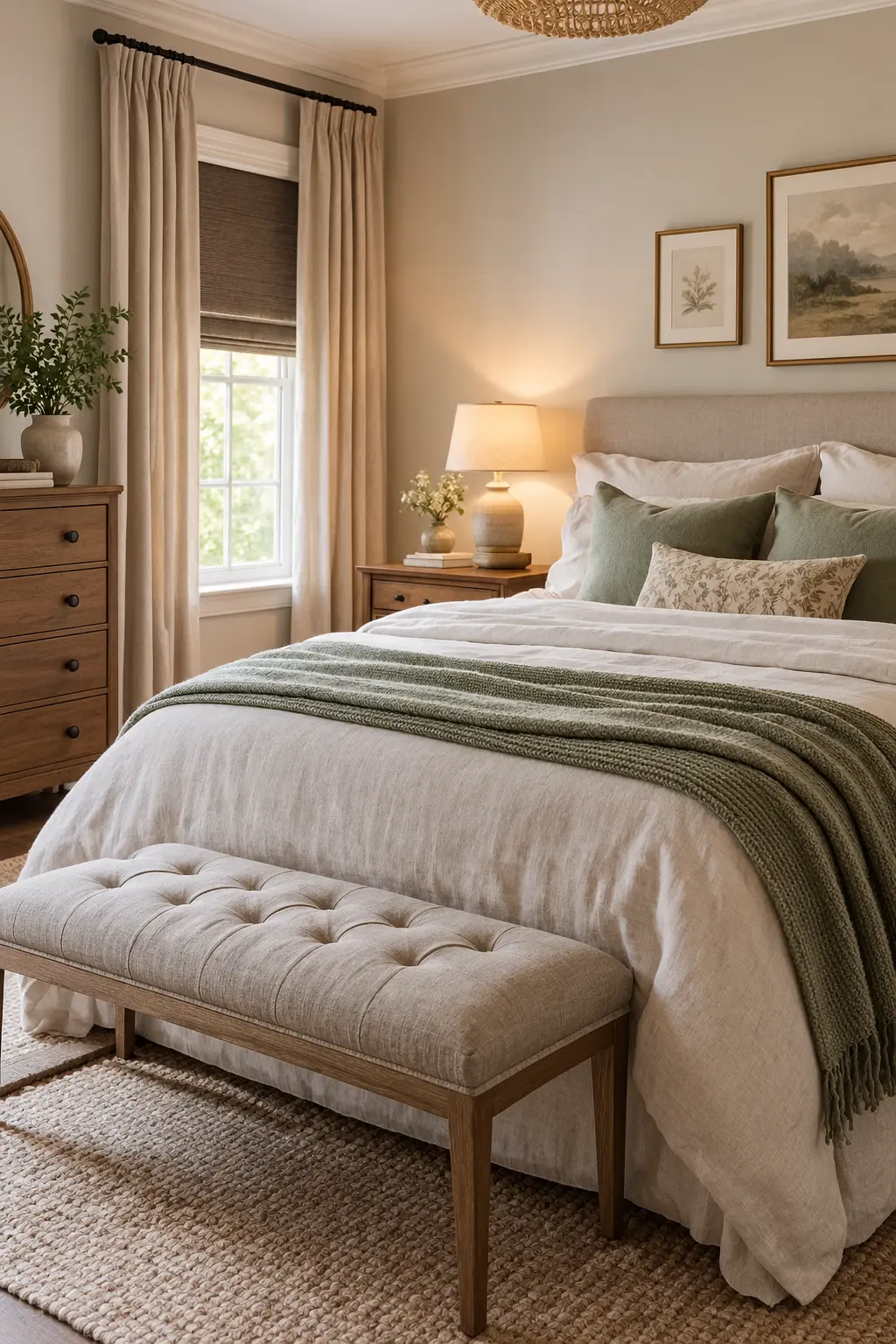
Add at least one low, warm light source at eye level or below: a bedside lamp, a plug-in sconce, or a small table lamp on a dresser. Use a warm-white bulb (2700K or lower) rather than daylight-toned ones — the warmer color temperature reads as “evening” to the eye in a way cooler light doesn’t, regardless of how bright it is.
Pro Tip: Put your bedside lamp on a switch or plug you can reach without getting up — a pull-chain lamp or a smart plug both work. If turning off the last light means walking back across the room, you’ll end up leaving the overhead on out of convenience, which undoes the whole point of layering the lighting in the first place.
Choose Bedding for How It Feels, Not Just How It Matches
A lot of bedroom styling starts and ends with finding a duvet cover that matches the wall color. That’s a reasonable starting point, but weight and weave matter more to how the bed actually feels than the exact shade. A heavier cotton or linen duvet drapes differently than a lightweight microfiber one — it holds its shape in folds instead of going flat and shiny, which is a big part of why some beds look effortlessly styled and others look slightly deflated no matter how nicely the colors coordinate.
Linen in particular is forgiving because its texture hides the wrinkles a “made bed” photo usually needs you to iron out of cotton. If you want a bed that looks intentionally undone rather than sloppy, linen or a linen-cotton blend does more of that work for you than a perfectly smooth matching set.
Get the Bed’s Position Right Before Anything Else
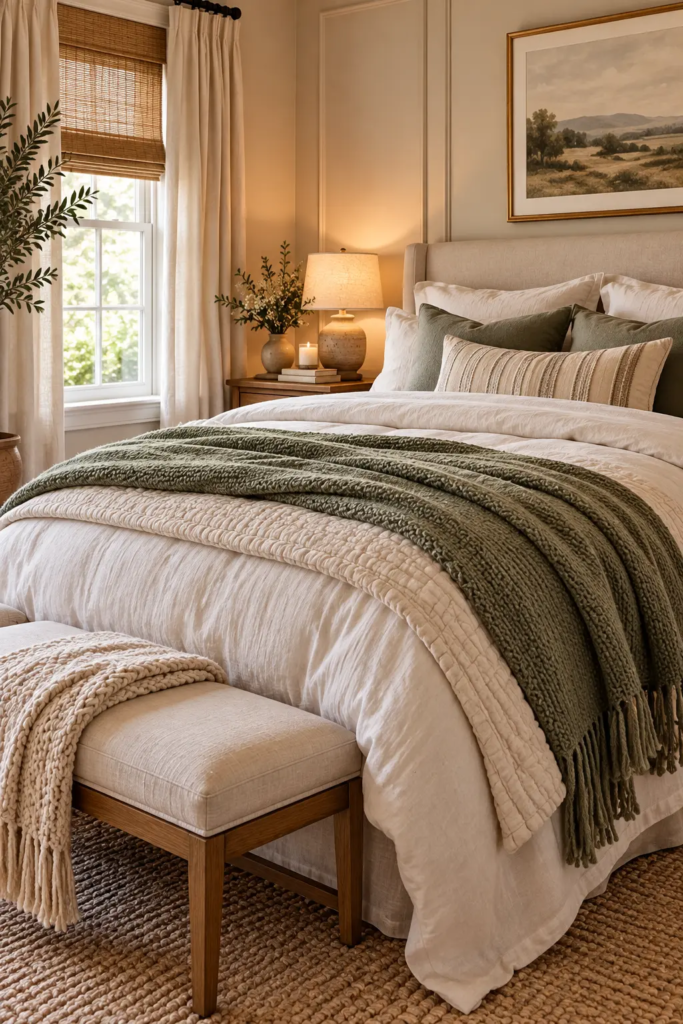
Furniture placement in a bedroom isn’t just about fitting the bed through the door — it affects how restful the room feels every single night. Where possible, position the headboard against a solid wall rather than floating in the middle of the room or backed up to a window. A solid wall behind you registers, even subconsciously, as more settled than an exposed position, and it also gives you a real surface to anchor a headboard or wall art against.
If your room’s layout forces the bed opposite the door, angle a nightstand or a low bench at the foot of the bed to create a slight buffer rather than leaving a direct, uninterrupted sightline from the doorway straight to the pillows. It’s a small layout adjustment that makes the room feel less like a hallway extension and more like an actual room.

Build a Nightstand That Works, Not Just One That Looks Nice
A nightstand styled purely for photos — one candle, one small stack of books, nothing else — usually gets overridden within a week by what you actually need at arm’s reach: a phone charger, a glass of water, reading glasses, maybe a book you’re mid-way through. Instead of fighting that, design around it.
Leave one drawer or a small tray specifically for charging cables so they’re accessible but not a visible tangle on the surface. A small dish or tray corrals rings, earplugs, or lip balm into one spot instead of scattering across the nightstand top. The goal isn’t to hide that you use the space — it’s to keep the things you use every night from looking like clutter.
Pro Tip: Mount your reading lamp’s switch (or use a lamp with a base-level switch, not just a pull chain up near the shade) so you can turn it off without sitting up and reaching. A surprising number of nightstand lamps look great but require an awkward half-sit to operate, which is the kind of friction that quietly makes a “cozy” reading setup less used than it should be.
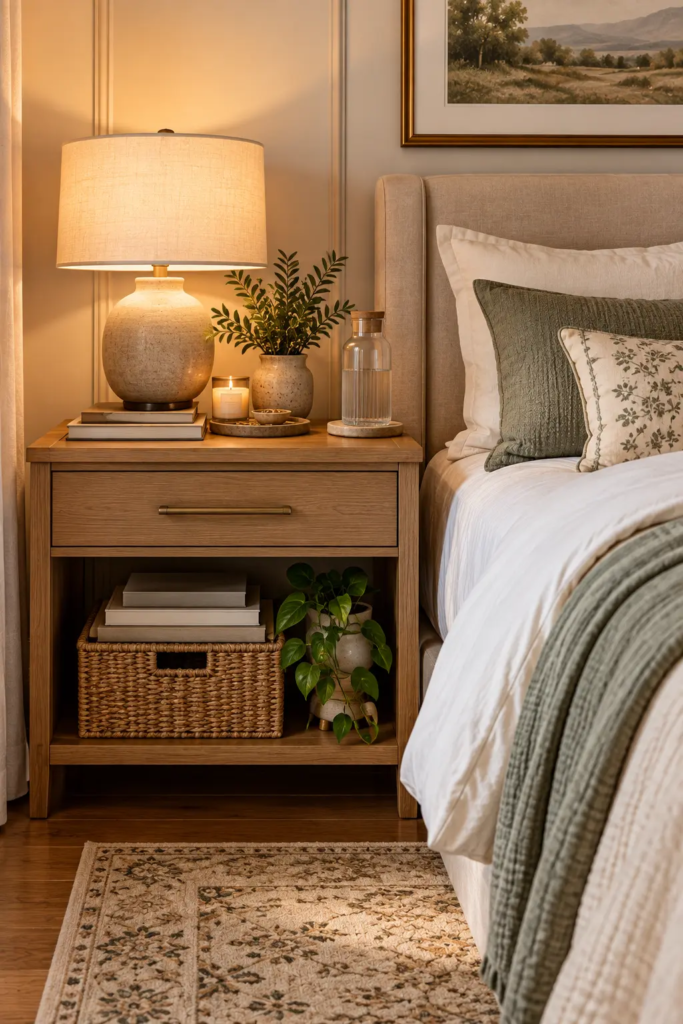
Pull the Color Palette Down a Notch From the Rest of Your Home
A bedroom doesn’t need to match the saturation level of your living room or kitchen. High-contrast color schemes and bold accent walls can work beautifully in spaces meant for activity and conversation, but in a room meant for winding down, a slightly desaturated, lower-contrast palette tends to feel calmer without reading as boring.
This doesn’t mean everything has to be beige. A muted sage, a dusty blue, or a warm greige all carry color without the visual energy of a saturated jewel tone or a stark black-and-white scheme. If you love a bold color, use it in one place — a piece of art, a single accent chair — rather than across walls, bedding, and curtains at once.

Layer Texture Instead of Buying a Matching Set
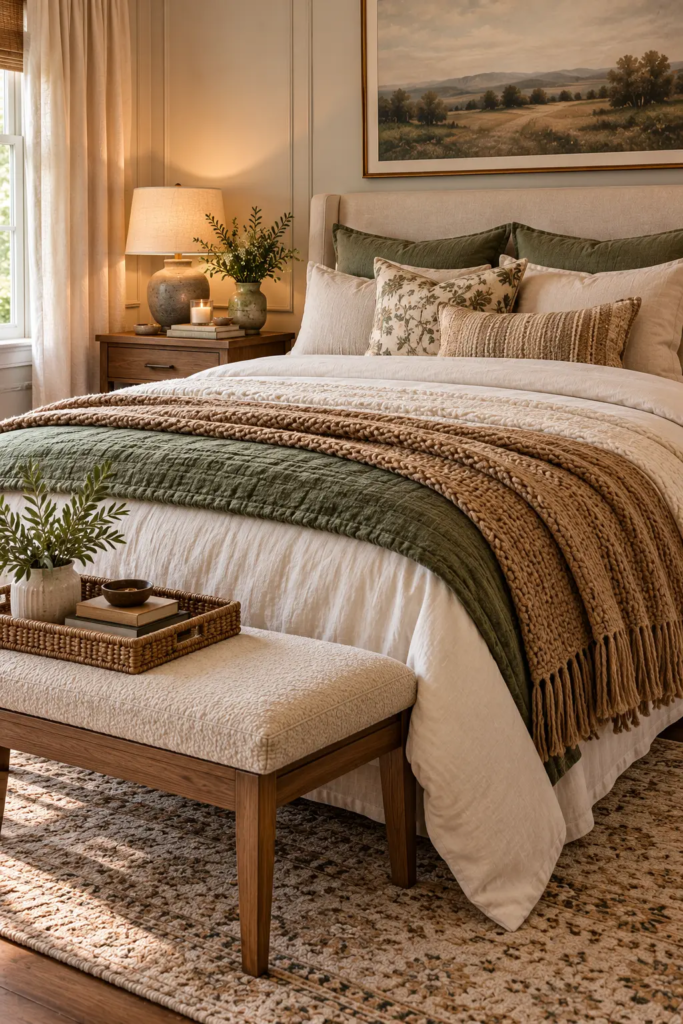
A bedroom made up entirely of one matching bedding-and-curtain set tends to look flatter than one built from a few coordinated but not identical pieces. A woven throw at the foot of the bed, a textured lumbar pillow, a rattan or wood element on a nightstand — these add the kind of visual depth a single matched set can’t, because they catch light differently from each other instead of reflecting it uniformly.
You don’t need many pieces to get this effect. Two or three textural elements — one soft (a knit throw), one structured (a woven basket or rattan tray), one natural (a wood-framed mirror or a small plant) — usually does more for how “finished” a room feels than adding a fourth matching pillow.
Control Natural Light Instead of Just Covering the Window
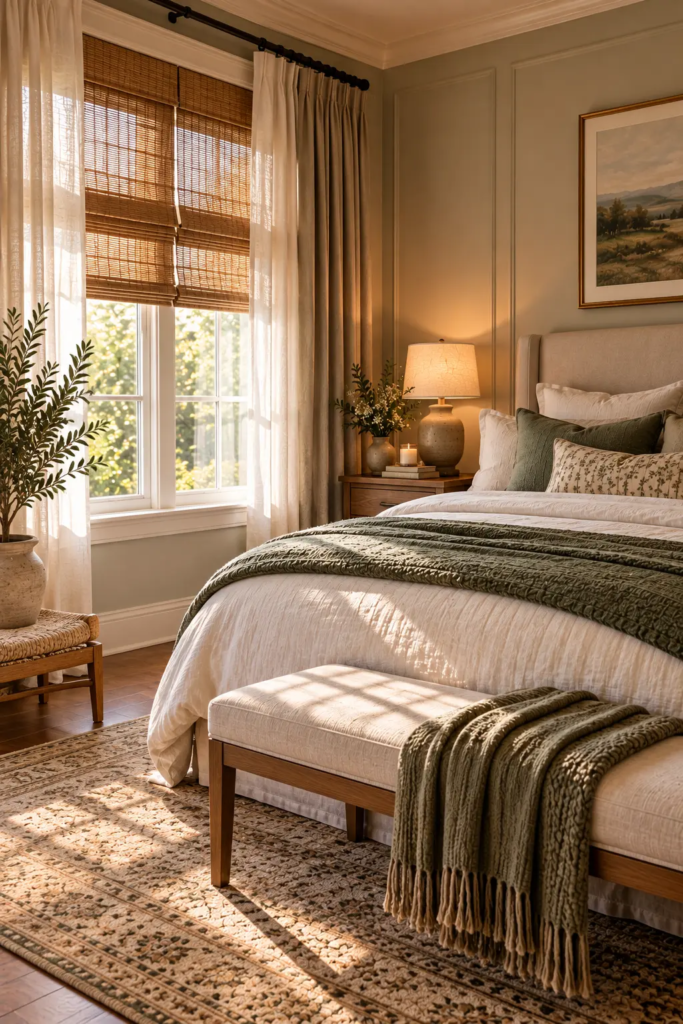
Curtains in a bedroom are doing real work, not just framing the window. If your room gets early morning sun and you’re a light sleeper, a sheer curtain alone won’t do much beyond softening glare — you’ll still wake up with the sunrise. Layering a blackout curtain behind (or in place of) a decorative sheer gives you both: the softness of light fabric during the day and real control over how dark the room gets at night.
Mount curtain rods a few inches above the window frame and a bit wider than the window itself, rather than exactly at the frame’s edges. It’s a small adjustment, but it lets the curtains fully clear the glass when open (so they’re not blocking any daylight during the day) and makes the window look larger than it actually is.
Pro Tip: If you’re renting and can’t install blackout curtains or hardware, a blackout curtain liner that clips onto your existing curtain rod (behind your current curtains) gets most of the light-blocking benefit without any drilling or a full curtain swap.
Add One Object That Means Something, Not Five That Don’t
It’s tempting to fill remaining surfaces — the dresser top, a shelf, a windowsill — with small decorative objects: candles, trinket trays, mini vases. In small doses this works, but past two or three items, most nightstands and dressers start to look cluttered rather than styled, and none of the individual pieces get to stand out.
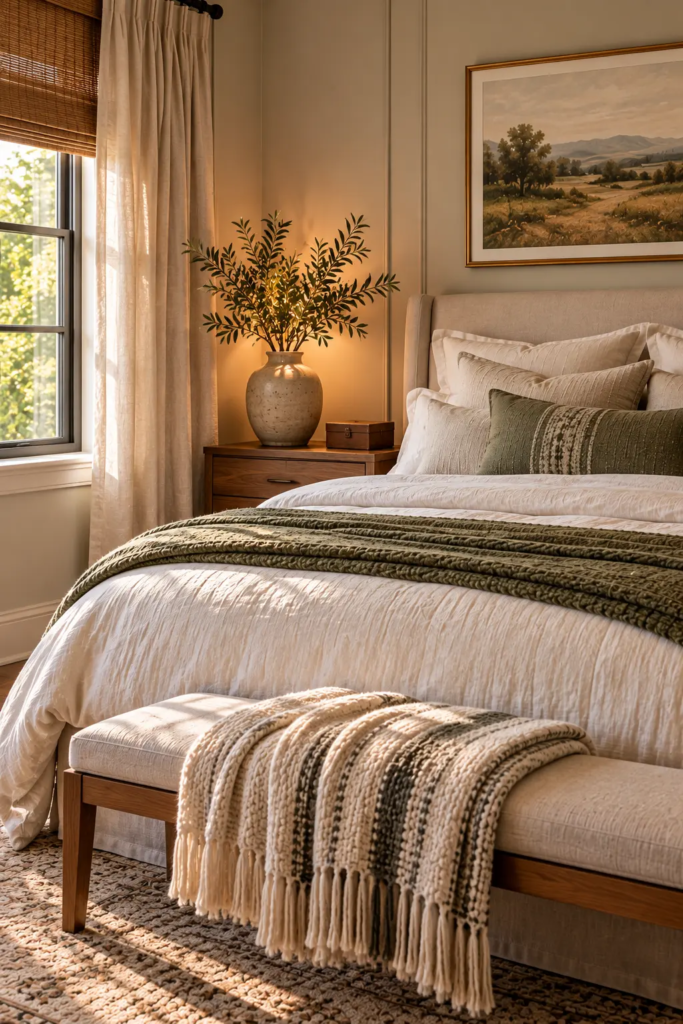
Instead, choose one object with actual meaning or visual weight — a piece of art you genuinely like, a ceramic vessel, a framed photo — and give it space around it rather than surrounding it with smaller filler pieces. A single well-chosen object on an otherwise clear surface reads as more intentional than five small ones competing for attention.
Common Mistakes to Avoid
- Relying on a single overhead light. It’s the fastest way to make a bedroom feel more like a hotel hallway than a place to unwind.
- Matching everything exactly. A perfectly matched bedding-curtain-pillow set often looks flatter than a few coordinated, non-identical pieces.
- Ignoring the door sightline. A bed directly facing an open door with nothing between them can make the room feel exposed, even if you can’t quite name why.
- Styling the nightstand for photos, not for use. It rarely survives contact with actual nightly habits, and looks messier once it does.
- Skipping blackout layers because sheers look nicer. You can have both — they just need to be layered, not chosen as an either-or.
Budget-Friendly Ways to Adapt These Ideas
Low budget: Swap your main bulb for a warm-white one, add a $20–30 plug-in lamp for layered lighting, and edit your nightstand and dresser down to fewer, more intentional objects — all free or under $50 total.
Mid budget: Add a textured throw and one or two accent pillows in a non-matching but coordinated texture, install a blackout liner behind your existing curtains, and reposition furniture if your bed currently faces the door directly.
Higher budget: Invest in a linen or linen-blend duvet set, a proper blackout curtain paired with a decorative sheer, and a statement art piece or mirror sized to actually anchor the wall above your headboard.
FAQ
What is the biggest mistake people make with bedroom decor? Relying entirely on a single overhead light and a perfectly matched bedding set. Both can look fine in photos, but neither accounts for how the room actually needs to function in the evening — dim, layered light and a bit of textural variation do more for the room’s everyday feel than a matched set ever will.
Should bedroom walls be a bold color or neutral? Either can work, but bold, high-saturation colors tend to add visual energy that’s better suited to living or social spaces. If you want color in the bedroom, a muted or dusty version of that color — rather than the most saturated version — tends to feel calmer without losing personality.
Do blackout curtains have to look plain? No — blackout lining can be added behind almost any decorative curtain, including patterned or sheer ones, so you don’t have to choose between style and light control. Clip-on blackout liners are a renter-friendly way to get this without replacing your existing curtains.
How do I make a small bedroom feel calm instead of cramped? Focus on reducing visual clutter on surfaces (one meaningful object instead of several small ones) and layering warm, low lighting rather than a bright overhead fixture. Both create a sense of calm independent of square footage, and both matter more in a small room where every surface is more visible at once.
Is it worth spending more on bedding than other decor? If you have to prioritize, bedding is one of the few decor choices you’re in direct physical contact with every night, so weight and material quality tend to be noticeable in a way that a decorative object on a shelf isn’t. A well-chosen duvet also does more visual work than most people expect, since it covers the largest surface in the room.
The Takeaway
Good bedroom decor isn’t just about finding pieces that match — it’s about choosing light, layout, and texture that hold up once you’re actually living in the room every night. These 8 bedroom decor ideas work because each one solves a real, specific friction point, not just a styling gap, which is why the results tend to last well past the first week of a fresh-room feeling.