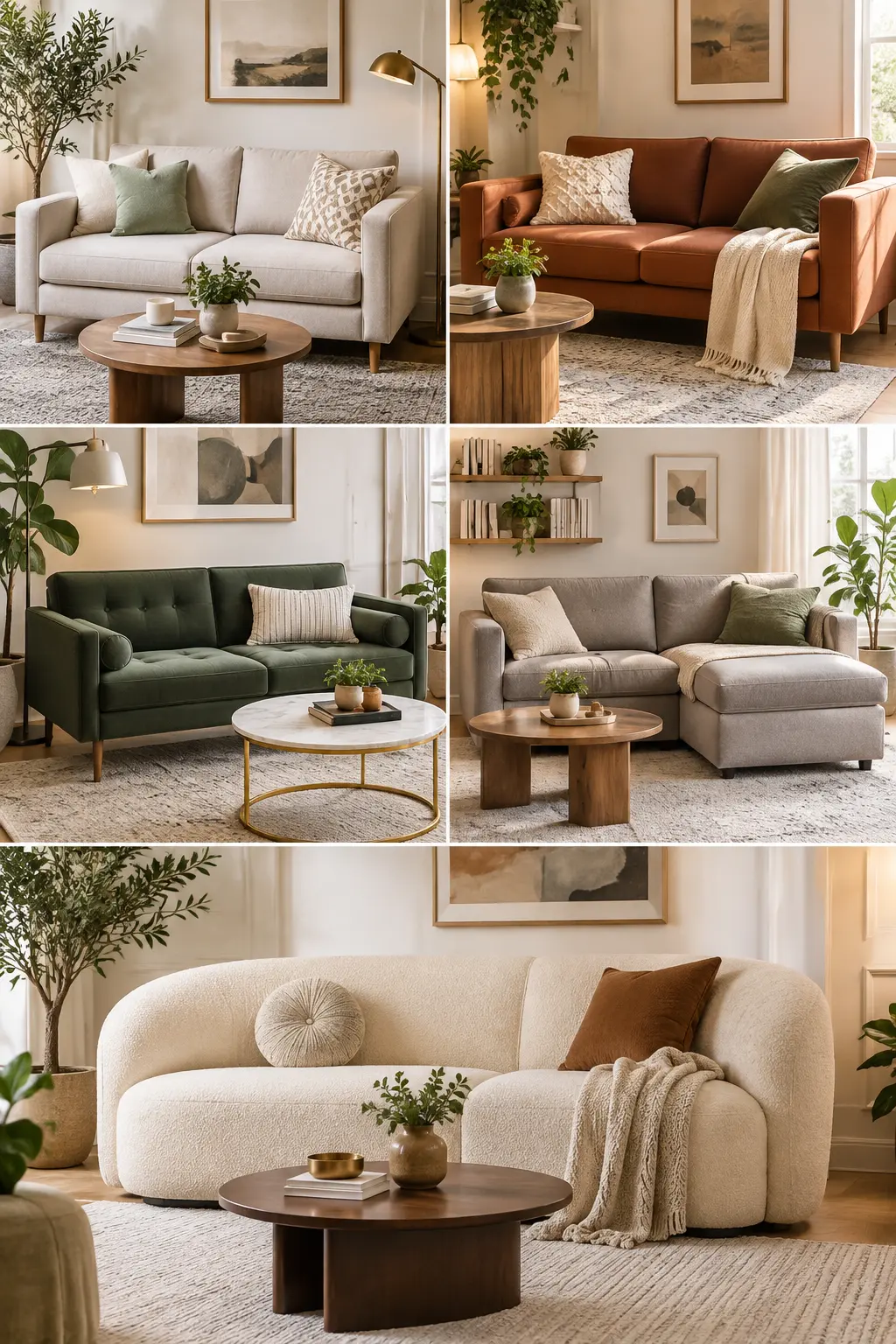
Most small-living-room sofa advice focuses entirely on floor space — will it fit against that wall, will there be enough room to walk around it — and skips the problem that actually gets sofas returned: whether the piece can physically get into the room in the first place. A sofa that measures perfectly for your floor plan can still be too wide for a hallway turn, too long for a stairwell’s diagonal clearance, or too tall to clear a low doorway header, and none of that shows up until delivery day.
Small living rooms tend to sit at the end of exactly the kind of tight hallways and narrow staircases that make this an actual risk, not a rare edge case. These five sofa styles are chosen specifically because their proportions make them easier to get through a tricky path, not just easier to fit once they’re inside.
Measure the Path Before You Measure the Room
Before comparing a single sofa dimension to your room, measure the actual path the piece has to travel: every doorway width along the route, any hallway turns (a 90-degree turn needs more clearance than a straight hallway, since the sofa has to pivot), and if there’s a staircase involved, the stairwell’s diagonal clearance rather than just its width. For a straight doorway with no turns, a sofa generally needs to be a few inches narrower than the doorway opening to clear comfortably; for any turn along the path, add real margin, since the sofa has to rotate through that turn diagonally, not just slide straight through.
[IMAGE: A tape measure held across a narrow hallway doorway, with a sofa cushion set beside it for scale comparison]
Pro Tip: For a staircase delivery, measure the stairwell’s diagonal clearance — the straight-line distance from the lowest point of the ceiling on one side of the stairwell to the floor on the opposite side — not just the stair width, since that diagonal is almost always the true limiting dimension on a turn or a low ceiling.
Sofa Type 1: The Track-Arm Sofa
A track-arm sofa has thin, minimal arms — often just a few inches wide — instead of the thick, rolled, or upholstered arms found on traditional styles. That slimmer arm width does two things for a small living room: it shaves several inches off the sofa’s overall footprint without reducing seat depth, and because the arms are the widest point on most sofa designs, a slim-arm silhouette is also one of the easier styles to angle through a tight doorway or hallway turn.
https://images.unsplash.com
Sofa Type 2: The Modular or Sectional-in-Pieces Sofa
Counterintuitively, a modular sofa — one built from separate sections that connect once assembled in the room — is often the safer choice for a genuinely difficult access path, not the riskier one. Because each individual piece is smaller than a single fixed-frame sofa, modular sections can navigate a tight stairwell or hallway turn that would stop a one-piece sofa entirely, then reassemble into a full sectional once they’re inside. This is worth specifically confirming before you buy: check that the listing describes true modular construction (separate, connecting pieces) rather than just a sectional that ships in one non-separable frame.
https://pixabay.com
Sofa Type 3:The Leg-Raised Loveseat
A loveseat with visible, raised wood or metal legs — rather than a skirted base that sits flush to the floor — does real work in a small room beyond the obvious space savings of a shorter overall length. The visible floor underneath the legs makes the piece read as lighter and smaller than the same loveseat on a solid base, which matters in a small room where visual weight affects how spacious the space feels as much as actual square footage does. Raised legs also typically mean a lower packed shipping profile, since the legs often ship separately and attach on-site, which can make the boxed sofa body easier to maneuver through a tight path than a piece that ships fully assembled.
Pro Tip: If legs ship separately (common on leg-raised designs), ask whether they attach with a bolt into a threaded insert or a simple screw into bare wood — bolted connections hold up far better over years of regular movement and vacuum-bumping than screws driven straight into particleboard.
https://pixabay.com
Sofa Type 4: The Apartment-Sized Sofa
Standard sofas commonly run 84 to 96 inches long, while apartment-sized sofas typically fall in the 67 to 78 inch range — a meaningful difference for both floor space and doorway clearance, since overall length often determines whether a sofa can pivot through a turn at all. Look specifically for “apartment sofa” or “condo sofa” in product descriptions rather than assuming any smaller-looking listing photo means a genuinely reduced footprint; photography can make similarly-sized sofas look different in scale, but the actual dimension in inches is what determines whether it clears your path.
https://pixabay.com
Sofa Type 5: The Storage or Sleeper Sofa for Multi-Functional Rooms
In a small living room that also needs to double as a guest space or extra storage, a sleeper sofa or a sofa with a lift-up storage seat solves a space problem that no amount of careful sizing on a regular sofa can. These pieces do tend to run heavier and sometimes bulkier than a standard sofa of the same length, because of the mechanism inside, so it’s worth double-checking the packaged shipping dimensions specifically (not just the assembled dimensions) against your access path, since the mechanism can add real bulk to the delivery box even when the finished piece looks like a normal sofa.
https://pixabay.com
Common Mistakes to Avoid
The most common mistake is measuring only the final room placement and skipping the path entirely, which is how sofas end up stuck at a stairwell turn on delivery day after weeks of careful room planning. A second mistake is trusting a listing’s overall width or depth without checking the arm width specifically, since arms are frequently the widest single point on a sofa and the dimension most likely to be the actual bottleneck at a doorway. Third, assuming a smaller-looking sofa in photos is automatically apartment-sized — always check the actual inch measurements rather than the visual impression a product photo gives.
Pro Tip: Many retailers list a “boxed” or “packaged” dimension separately from the assembled dimension — for any tight access path, compare your doorway and hallway measurements against the packaged dimension first, since that’s the size the piece will actually be during delivery, before anything gets unwrapped or assembled on-site.
[INTERNAL LINK: related post on living room aesthetic]
Budget-Friendly Small-Space Sofa Shopping
On a lower budget (under $500), a track-arm loveseat in a durable, easy-clean fabric like a performance weave gives you the slimmest profile and easiest delivery for the least money, without sacrificing daily comfort. At a mid budget ($500–$1,200), an apartment-sized sofa with removable, washable cushion covers balances a fuller seating profile with practical long-term maintenance. At a higher budget ($1,200+), a modular sectional lets you solve both the access problem and future flexibility at once, since individual pieces can be rearranged or added to later if your space or needs change, which a fixed-frame sofa at the same price point can’t offer.
[IMAGE: Three-tier budget flat-lay for small-space sofa shopping — a track-arm loveseat swatch, then an apartment sofa fabric sample, then modular sectional pieces]
FAQ
What’s the ideal sofa depth for a small living room? A seat depth of 20 to 22 inches works well for most small rooms, since it keeps the sofa from eating into walking space while still offering real back support — deeper seats (24 inches or more) look inviting in photos but can make a small room’s remaining floor space feel cramped. If floor space is especially tight, prioritize depth reduction over length reduction, since depth affects the room’s walkway more directly.
How do I know if a sofa will fit through my stairwell before I order it? Measure the stairwell’s diagonal clearance at its tightest point, typically where the ceiling is lowest relative to the stair below it, and compare that to the sofa’s boxed diagonal measurement (length and depth combined at an angle), not just its width. When in doubt, many retailers or delivery services offer a pre-delivery assessment for tight spaces — it’s worth asking before committing to a piece with a difficult return process.
Is a loveseat always a better choice than a full sofa for a small room? Not necessarily — a loveseat saves length but can look undersized and awkward in a room that otherwise has generous proportions, making the room feel unfinished rather than efficient. An apartment-sized sofa in the 67 to 78 inch range often gives a more proportional, complete look than a loveseat while still fitting comfortably in most small living rooms.
Do modular sofas cost more than a regular sofa of the same size? Modular sofas typically cost somewhat more than an equivalent fixed-frame sofa, largely because of the additional hardware and connective mechanisms in each section. For a genuinely difficult access path, that premium is often worth it, since it can be the difference between a sofa that arrives successfully and one that has to be returned.
What fabric holds up best on a small sofa that gets daily use? A tightly woven performance fabric — often polyester or a poly-blend labeled for high abrasion resistance — handles daily use better than a loosely woven natural fiber like raw linen, which shows wear and pilling faster in high-contact areas like arm rests and the front seat edge. Small living rooms tend to see more concentrated daily use per square foot than larger rooms, since there’s simply less alternate seating, so durability matters more here than the fabric’s initial texture or feel.
The Real Takeaway
The best sofa for a small living room isn’t only the one that fits the floor plan — it’s the one that can actually get there, through whatever doorway, hallway turn, or stairwell stands between the truck and your living room. Measure the path first, choose a silhouette (track arms, raised legs, modular pieces) that matches what that path actually allows, and let the room’s floor plan be the second filter rather than the first.
Most living room mirror advice stops at “hang one across from a window to bounce light around the room,” which is true but incomplete. A mirror doesn’t just reflect light — it reflects whatever’s in front of it, and that’s the part most guides skip. Hang a beautiful mirror across from a cluttered bookshelf, a…
A green sofa can dominate a room before you’ve added anything else. That’s the advantage—and the problem. Choose the wrong wall color, rug, or accent pieces, and the sofa starts looking disconnected. Choose the right supporting pieces, and it becomes the easiest starting point for the entire room. The key isn’t finding more green accessories….
Most French country dining room photos you’ve saved are shot in rooms with 10-foot ceilings, a stone fireplace, and enough square footage to fit a table for twelve with room to spare. Your dining room probably isn’t that. It’s more likely an 11×13 space off the kitchen, maybe with a builder-grade light fixture you’re planning…
Curtains are often one of the most overlooked elements in home décor, yet they have the power to completely transform a living room. Whether you’re aiming for a cozy retreat, a modern gathering space, or a bright and airy atmosphere, the right curtains can make all the difference. From colors and fabrics to patterns and…
Most black bathrooms fail for the same reason: someone paints every surface the same shade of black and calls it moody. It isn’t moody. It’s a parking garage with a toilet in it. The bathrooms that actually work — the ones that look expensive rather than experimental — treat black as a material to place…
White walls get blamed for a lot of living rooms that feel flat, cold, or generic — but the actual problem is rarely the color itself. It’s usually one of two things: a white with the wrong undertone for the room’s light, or a room that’s relying on the wall color alone to do all…