French Country Dining Room Ideas for Rooms That Aren’t Château-Sized
Most French country dining room photos you’ve saved are shot in rooms with 10-foot ceilings, a stone fireplace, and enough square footage to fit a table for twelve with room to spare. Your dining room probably isn’t that. It’s more likely an 11×13 space off the kitchen, maybe with a builder-grade light fixture you’re planning to swap out, and a table that needs to seat six without anyone’s chair backing into the china cabinet.
That gap — between the pin and the actual room — is where most French country dining rooms go wrong. People chase the look piece by piece: a toile chair here, a wrought-iron chandelier there, a distressed hutch because it “felt French.” The result reads like a themed restaurant instead of a room someone actually lives in. This guide is built around the opposite approach: get the bones right first, then layer in the details that make a normal-size dining room feel collected over time rather than shopped in one weekend.
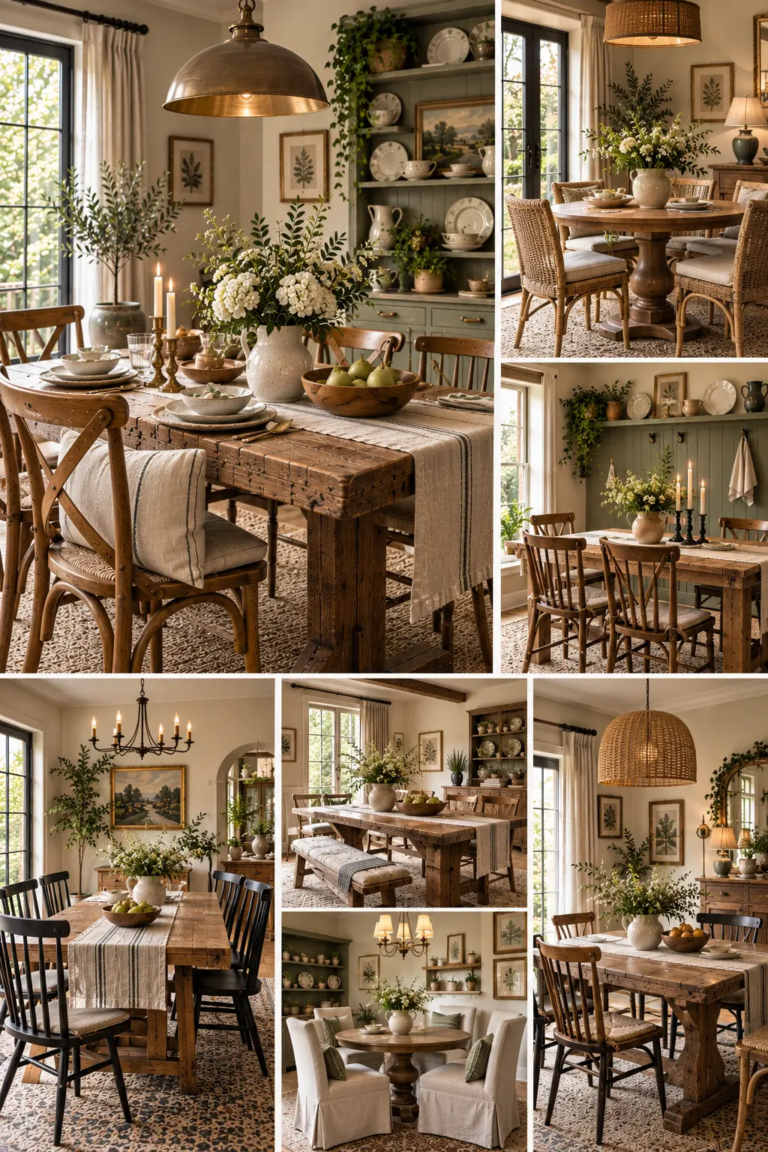
[IMAGE: A mid-size dining room, roughly 11×13 feet, with a rectangular oak trestle table, six mismatched wood and rush-seat chairs, and a linen chandelier — warm afternoon light through a single window, table set simply with a runner and no flowers]
What “French Country” Actually Means (and Where It Goes Wrong)
French country design is really French provincial farmhouse style filtered through decades of American reinterpretation — worn wood, warm neutrals, a little bit of iron or wrought detail, and fabrics that look like they’ve faded in the sun rather than been printed to look faded. It’s not the same as cottagecore dining room styling, which leans more into florals, ruffles, and a deliberately romantic, storybook feel. French country is quieter and more architectural — it depends on proportion and material as much as pattern.
The failure mode is treating it as a shopping list instead of a material palette. If every piece in the room is trying to say “French country” on its own — a toile-covered chair, a distressed console, an ornate mirror, a wrought-iron chandelier, a rooster print — the room ends up loud and theme-y. The pieces that actually read as authentic tend to be quieter individually and only add up to the style together: turned wood legs, worn or waxed finishes, linen or cotton in muted colors, and a couple of iron or brass accents instead of a dozen.
Pro Tip: If you’re not sure whether a piece will read as French country or just “old,” look at the joinery and hardware. Turned or tapered legs, visible dovetail joints, and simple iron or brass pulls (not ornate scrollwork) tend to look intentional. Heavily carved, gilded, or scrollwork-covered pieces usually tip into “costume” territory in a smaller room.
Choosing a Table and Chairs That Don’t Look Matchy
The dining table is the piece that sets the tone for everything else, and it’s also the piece people over-shop. A table-and-chair set bought as a matched unit is the fastest way to make a French country dining room look like a showroom vignette instead of a real room.
Wood tone and table shape
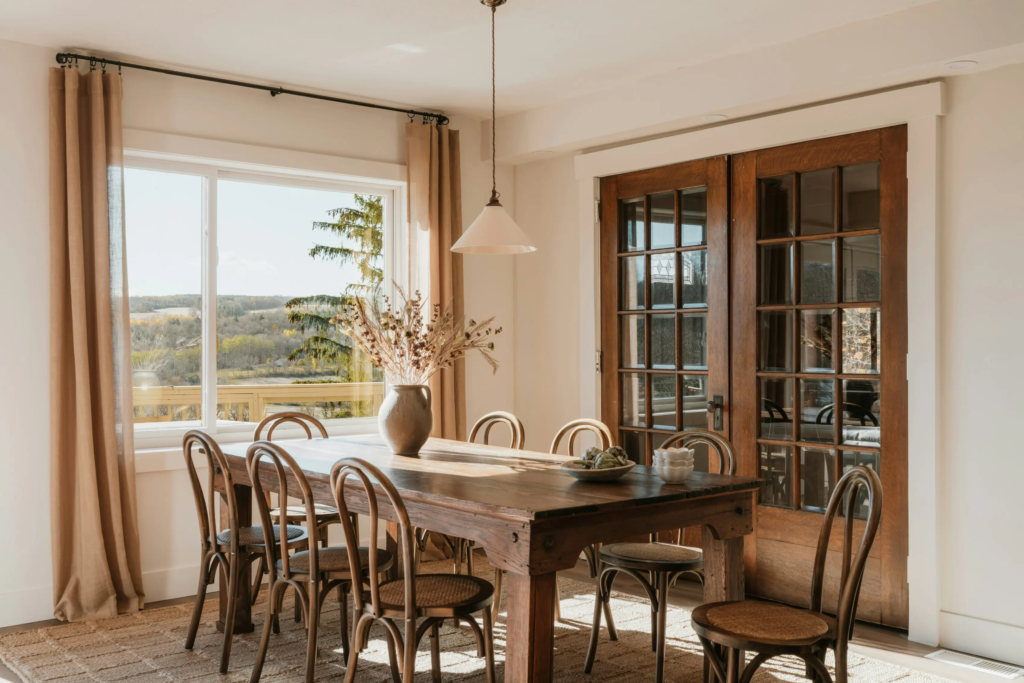
A rectangular or oval trestle table in oak, elm, or a warm walnut works better than a round pedestal table in most standard dining rooms, because a trestle base keeps the legs out of the way of chair placement — important when you’re working with 36 to 40 inches of clearance on each side rather than the 48-plus inches a formal dining room would have. Look for a finish with visible grain and some tonal variation rather than a flat, uniform stain; that variation is what reads as “worn over generations” instead of “new.”
For a room roughly 11×13 feet, a table between 60 and 72 inches long leaves enough walking space around a six-person setup without crowding a sideboard or hutch against the opposite wall.
Mixing chair styles on purpose
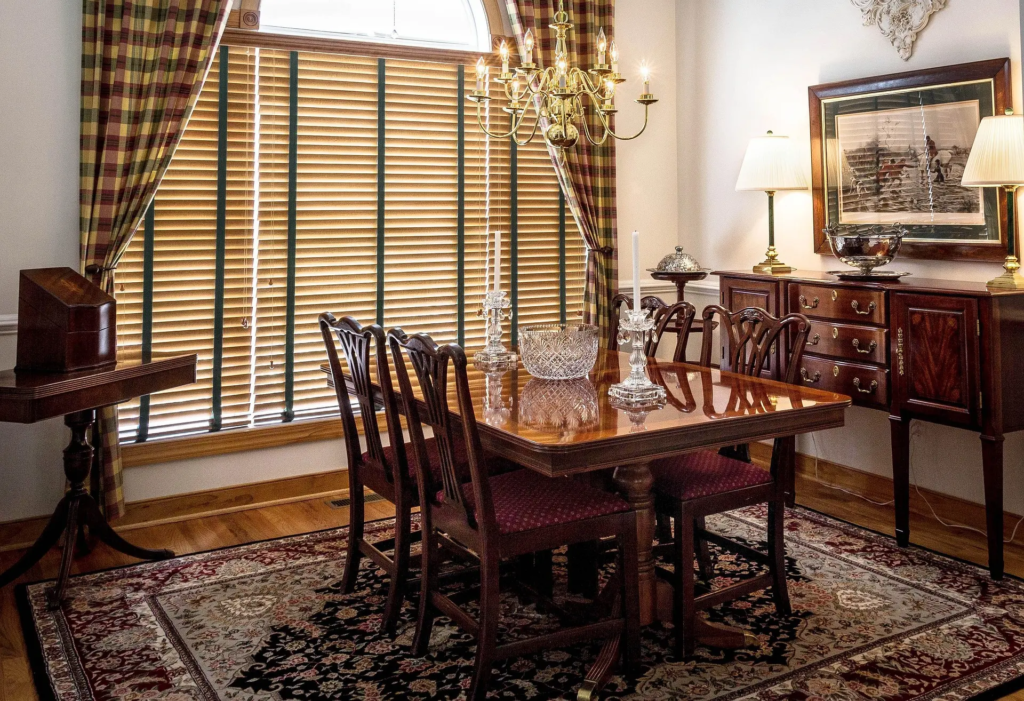
Buy dining chairs separately from the table, and mix at least two styles: a set of four simple wood or rush-seat chairs for the sides, plus two chairs with arms or a slightly different silhouette for the ends. This is one of the most reliable ways to avoid the matched-set look, and it mirrors how these rooms would have actually been furnished over time — pieces acquired at different points rather than delivered on one truck.
Making the Layout Work in a Standard-Size Room
French country dining rooms in magazines often have a hutch, a sideboard, a bar cart, and a table with leaves — because the room is 16 feet wide. In a smaller dining room, you generally get to pick two: the table, plus either a sideboard or a hutch, not both.
Prioritize the sideboard over the hutch if the room doubles as a walkway to the kitchen — a 16 to 18-inch-deep sideboard against one wall keeps the traffic path clear, while a hutch’s depth (often 20+ inches) can eat into circulation space in a room under 12 feet wide. If the dining area is part of an open kitchen and dining layout, keep furniture depth shallow along the kitchen-facing wall specifically, since that’s the path people use most.
Leave at least 36 inches between the back of a pulled-out chair and the nearest wall or furniture piece — 42 to 48 inches if that side of the table is also a walking path. This is the number that gets skipped most often, and it’s the reason a lot of French country dining rooms feel cramped even when the furniture itself is appropriately scaled.
Pro Tip: Measure your chair’s pulled-out depth, not just its footprint at the table — a chair with arms or a curved back can add 6 to 8 inches beyond what you’d expect when someone actually sits down and pushes back from the table.
A Color Palette That Reads Warm, Not Beige
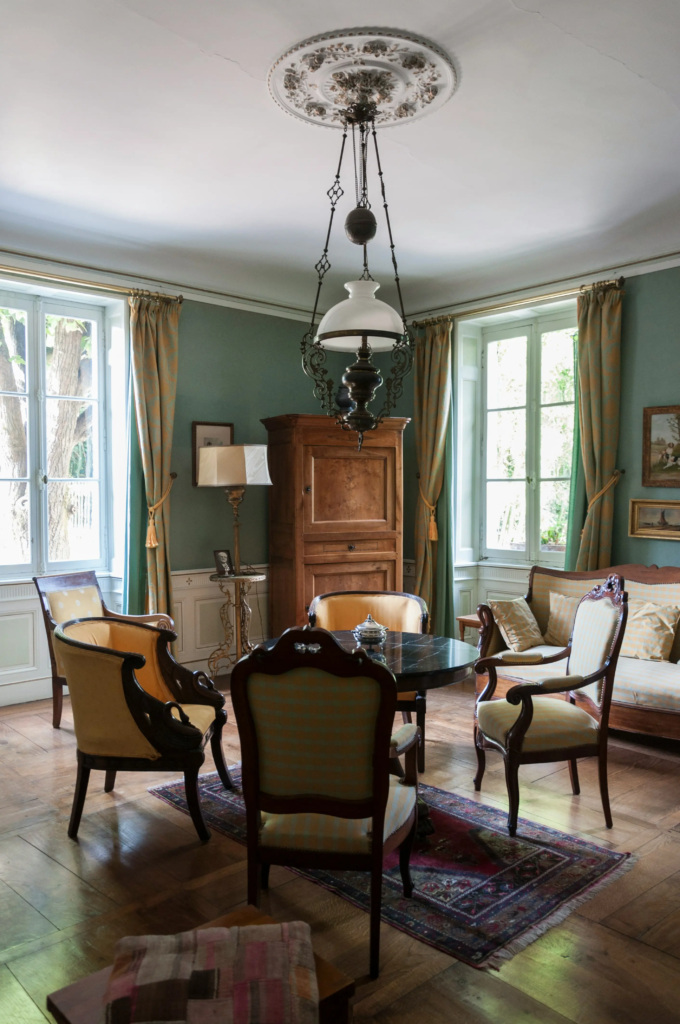
French country color palettes get flattened into “beige and cream” more often than any other style, and that’s usually where rooms start to feel flat instead of warm. The actual palette leans into warm neutrals with one or two saturated accents — think butter yellow, faded terracotta, sage, or a muted blue, used in textiles rather than painted across every wall.
If you’re choosing a wall color for the room itself, a warm off-white or pale stone tone on the walls gives the furniture and textiles room to carry the color, rather than competing with them. Save the more saturated tones for chair cushions, a table runner, or window treatments — pieces that are easy to change later if the palette starts to feel dated.
[IMAGE: Dining room wall in warm stone-white paint with a sage green table runner and mismatched terracotta and cream ceramic pieces on an open shelf]
Materials and Textures — French Country vs. Farmhouse
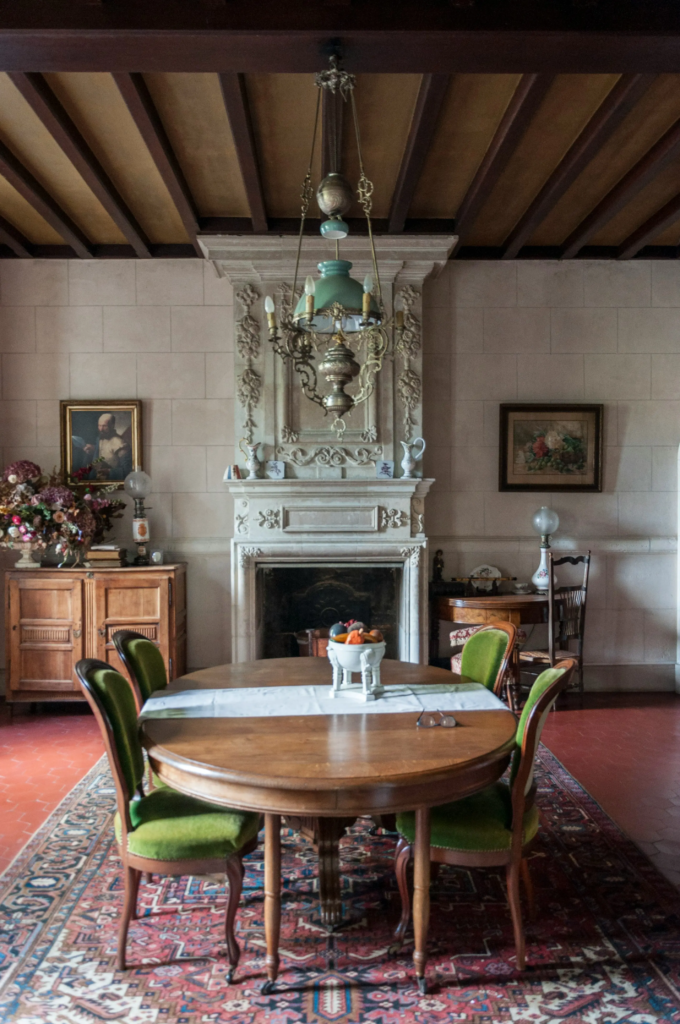
French country and modern farmhouse get lumped together constantly, but the material choices that separate them matter if you don’t want the room to read as generic “rustic.” Farmhouse leans toward shiplap, black metal accents, and a more graphic black-and-white palette. French country leans toward plaster or lightly textured walls, warm wood tones instead of gray-washed or whitewashed finishes, and iron or brass rather than matte black hardware.
Linen is the fabric that does the most work in this style — on chair cushions, table runners, or simple curtain panels — because its slightly uneven, slubby texture reads as lived-in rather than crisp. Cotton toile is a classic French country textile too, but it’s easy to overuse; one chair, one set of cushions, or a runner is usually enough in a smaller room before it starts to feel costume-y again.
Pro Tip: If you’re drawn to toile but worried about it looking dated, use it only on the seat cushions of the end chairs rather than all six chairs — it reads as an intentional accent instead of a matched pattern taking over the room.
Styling the Table and Walls Without Overdoing It
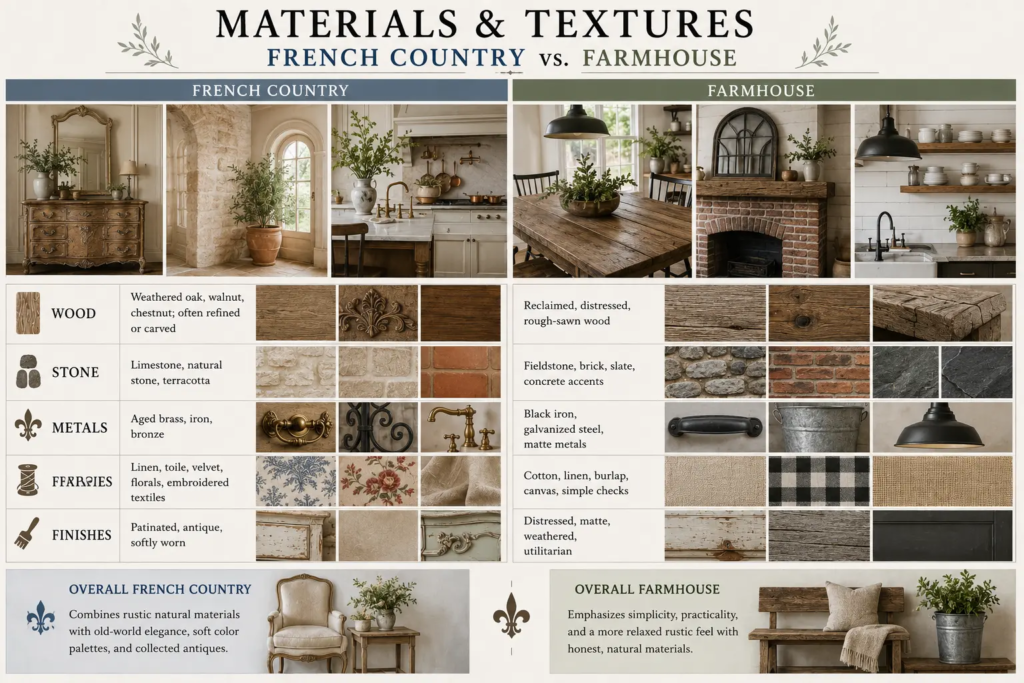
Table styling is where a lot of French country dining room decor tips into clutter. A linen runner, a low ceramic bowl or a single pitcher of greenery, and mismatched candlesticks in two heights is usually enough for everyday styling — save the fuller tablescape with chargers and multiple centerpiece elements for occasions when the table is actually set for a meal.
On the walls, a single large piece of art or a grouping of two or three smaller framed botanical prints reads more intentional than a gallery wall packed with French-themed signage and “Paris” typography prints, which is one of the fastest ways to make the room feel like a theme rather than a style. An antiqued or slightly foxed mirror above a sideboard does more for the room’s character than several small decorative objects scattered across shelves.
Common Mistakes to Avoid
Buying the matched furniture set. As covered above, a table-and-six-chairs set bought as one unit is the single fastest way to make the room look staged rather than styled. Buy the table and chairs from different sources, even if it takes longer.
Over-committing to one motif. Roosters, toile, and “Paris” signage in the same room push French country into caricature. Pick one motif at most, and use it once.
Skipping the minimalist dining room principle of restraint entirely. French country doesn’t have to mean maximalist. A room with fewer, better pieces — a good table, well-chosen chairs, one lighting moment — will read as more authentic than one crammed with every French country signifier at once.
Choosing cool-toned wood or gray finishes. Gray-washed or whitewashed wood reads as modern farmhouse or coastal, not French country. Warm honey, oak, or walnut tones are what separate the two styles at a glance.
Ignoring scale in a smaller room. An oversized wrought-iron chandelier or a hutch that’s too deep for the space will dominate a standard-size room instead of anchoring it. Measure before you fall in love with a piece online.
Budget-Friendly Ways to Get the Look
You don’t need to source antiques to get a room that reads as authentically French country. A few ways to keep costs down without the room looking cheap:
- Buy chairs secondhand or unfinished, then finish them yourself. A warm wood stain or a chalk-paint-and-wax finish on secondhand chairs costs a fraction of new French-country-branded seating, and the slight imperfection of a hand-finished piece actually helps the look.
- Skip the chandelier upgrade initially. A budget linen or rattan pendant shade over an existing fixture gets most of the visual effect for under $100, and can be swapped for something more substantial later.
- Use textiles to carry the color and pattern instead of furniture. A linen table runner and a few yards of toile for seat cushions cost far less than buying pattern-heavy furniture, and they’re easy to change if your taste shifts.
- Look for iron or brass hardware swaps before replacing whole pieces. Updating drawer pulls on an existing sideboard or hutch is a low-cost way to shift a piece toward French country without buying new furniture entirely.
Pro Tip: When buying secondhand wood furniture for this style, prioritize solid wood construction over a “perfect” finish — a few scratches or an uneven stain sand out or refinish easily, but a piece built from veneer over particleboard won’t hold up to the kind of hand-finishing this style often calls for.
FAQ
Is French country dining room style outdated? The heavier, more ornate version popular in the 2000s — dark wood, elaborate scrollwork, a lot of gold — reads dated now. A more restrained version with warm wood, linen textiles, and simple iron accents has stayed relevant because it leans on material quality rather than trend-driven decorative details.
What’s the difference between French country and modern farmhouse? Modern farmhouse tends toward black-and-white palettes, shiplap, and matte black hardware. French country uses warmer wood tones, plaster-like wall textures, and iron or brass instead of black metal, with more color variation in textiles.
What color should I paint a French country dining room? A warm off-white, pale stone, or soft butter tone on the walls works well as a backdrop, letting furniture and textiles carry more saturated color. Avoid stark white or cool gray, which tend to read as more modern farmhouse or Scandinavian.
Do I need a chandelier for a French country dining room? No — a pendant with a linen or rattan shade, or a simple lantern-style fixture, achieves the same warm, textural effect for less cost and works better in rooms with standard 8-foot ceilings, where an oversized chandelier can feel disproportionate.
How do I make a small dining room feel French country without it looking cluttered? Choose one furniture “moment” to prioritize — usually the table and chairs — and keep the rest of the room simpler. A shallow sideboard, one lighting fixture, and restrained wall art will read as intentional, while trying to fit a hutch, bar cart, and full gallery wall into a small room usually reads as crowded.
The Practical Takeaway
A French country dining room works best when you stop trying to make every piece announce the style on its own. Get the table and chair proportions right for your actual room size, lean on warm wood and linen instead of buying anything labeled “French country,” and let the room fill in over time rather than arriving fully formed from one order. That’s what separates a dining room that feels collected from one that feels like a set — and it’s a lot more forgiving of a normal-size home than the magazine version ever lets on.