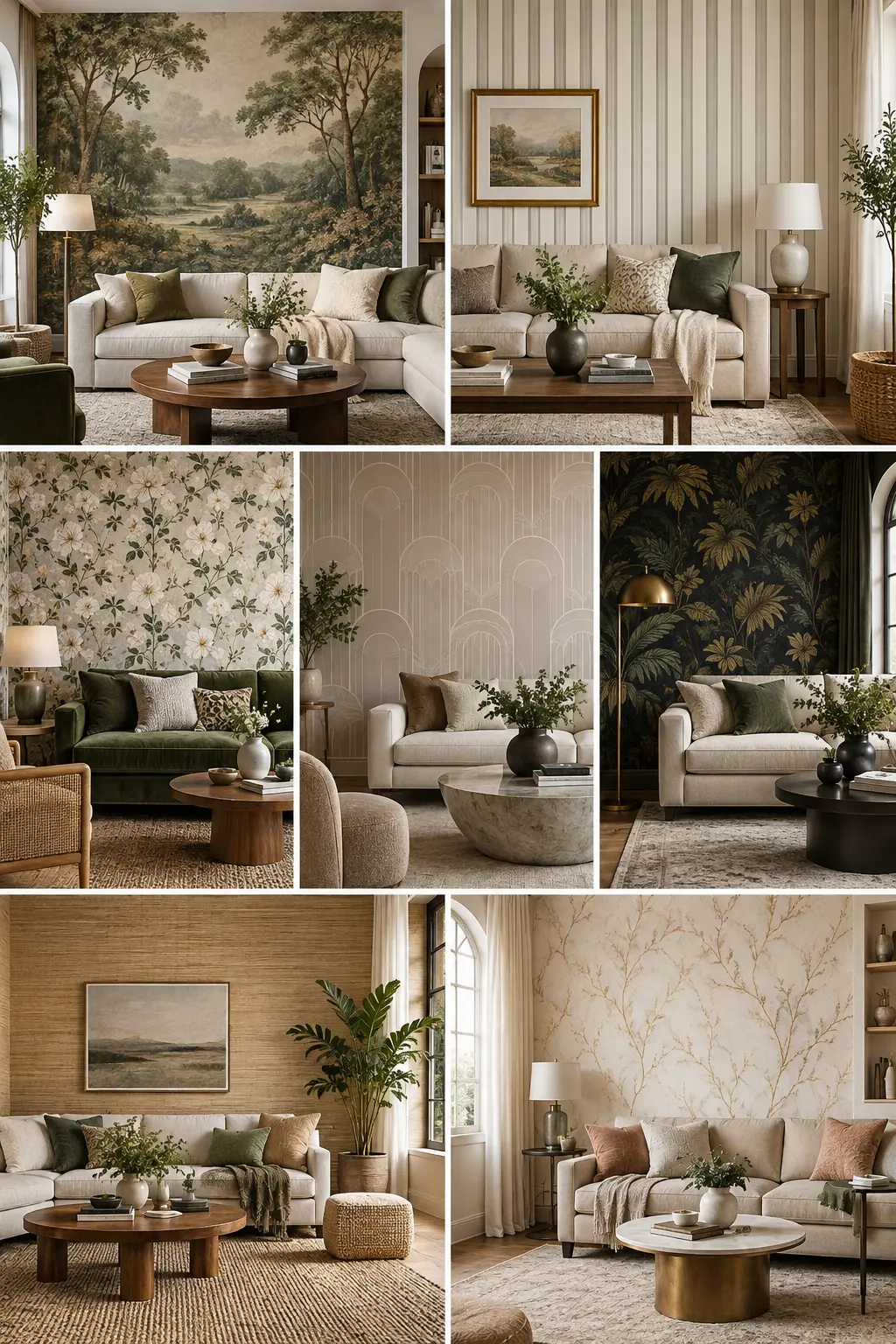
7 Wallpaper Ideas for Living Rooms With a Real Problem to Fix
Most people choose living room wallpaper the way they choose a throw pillow: they see a pattern they like, buy a few rolls, and hope it works. Then it goes up and the room feels smaller, or the ceiling feels lower, or the seam lines catch every bit of afternoon light. Wallpaper isn’t decorative in the way a pillow is — it’s structural to how a room reads. Pattern scale, sheen, and placement change the perceived shape of a space before anyone even registers the design on the paper.
So before you fall in love with a pattern, it helps to flip the process: start with what’s actually wrong with your living room, then pick the wallpaper suited to that problem. Below are seven approaches, each tied to a specific living room constraint — small footprint, low ceiling, poor light, open-concept layout, rental restrictions, an awkward architectural feature, or heavy daily wear.
How Wallpaper Actually Changes a Room’s Proportions
Before the specific ideas, it’s worth understanding the three variables that do the real work: scale, direction, and sheen.
Pattern scale relative to the wall matters more than the pattern itself. A motif with a 24-inch repeat on an 8-foot wall reads as one or two full “moments” — bold and graphic. The same motif with a 6-inch repeat on that wall reads as texture from across the room. Neither is wrong, but they solve different problems: large scale adds drama and can make a big blank wall feel intentional, while small scale adds richness without visually shrinking the space.
Directional pattern — vertical stripes, trellis, ogee — pulls the eye up or across, which is why it’s the go-to fix for ceiling height, not floor space. It doesn’t add square footage; it changes where your eye travels first.
Sheen and finish determine how the paper interacts with your existing light. A matte, deep-toned paper in a dim room absorbs what little light there is and can make the room feel like a cave after 4pm. A paper with a subtle metallic thread or pearlescent finish bounces available light back into the room instead.
Pro Tip: Hold a sample against the wall at the time of day you actually use the room most — evening lamp light reads completely differently than the bright daylight showroom conditions most samples are viewed under.
1. Small or Boxy Living Room: Go Big, But Go Small in Coverage

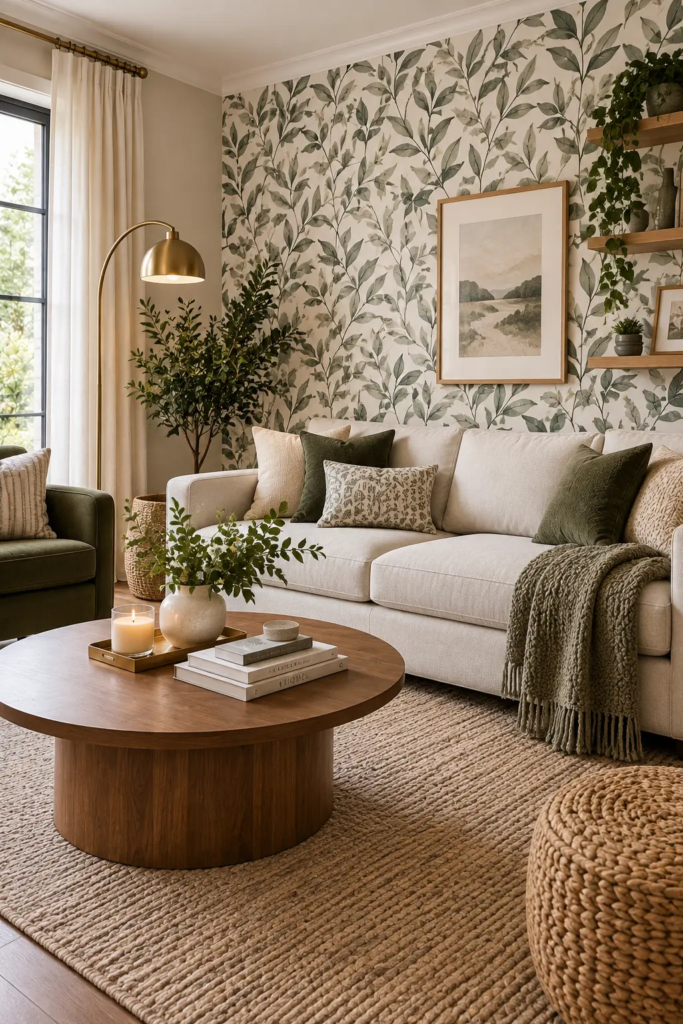
Counterintuitively, an oversized pattern can make a small living room feel larger, not smaller — but only if you don’t wallpaper all four walls. Papering a single accent wall (usually the one your sofa backs onto, or the wall directly opposite the entry) with a large-scale botanical or abstract print gives the eye one clear focal point instead of registering the room’s actual small dimensions. Keep the remaining three walls a soft, matching-family solid so the papered wall reads as a deliberate feature, not a container.
A 5-inch-plus pattern repeat works best here; anything busier on all sides of a small room tends to visually shrink the ceiling and close the space in.
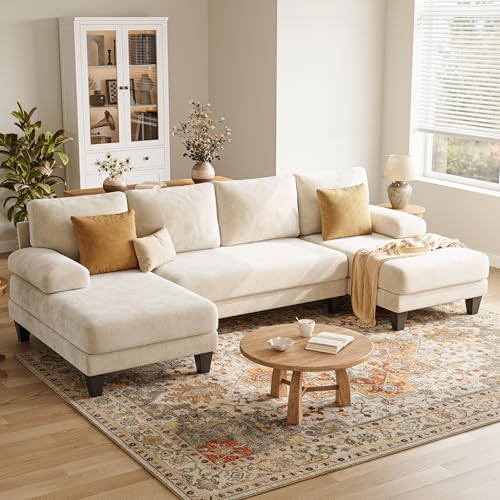
- 【112 INCH SPACIOUS U-SHAPE】 The 112″ L x 35 W x 47″ D u shaped couch is easy fits perfectly in most living rooms, genero…
- 【2 BOXES DOOR to DOOR DELIVERY】 We’ve packed this u shaped sectional couch in 2 boxes for easily carrying. If you have a…
- 【PLUSH CUSHIONS AND PILLOWS】 You’ll love lounging on the super soft, deep cushions of this sectional couches for living …
2. Low Ceilings: Let a Vertical Stripe Do the Work

For a living room with 8-foot or lower ceilings, a vertical stripe, narrow trellis, or slim linear pattern is one of the few genuinely reliable fixes. Run it floor to ceiling, uninterrupted by a chair rail (chair rails actually work against you here by cutting the wall into two horizontal bands, which shortens the room visually). A stripe width between 2 and 4 inches, in two closely related tones rather than high-contrast black and white, reads as height rather than as a barbershop pole.
Pro Tip: Extend the same wallpaper a few inches onto the ceiling in a narrow border, or continue it fully across the ceiling — this erases the visual “stop line” where wall meets ceiling and is often more effective at adding perceived height than the stripe alone.
3. Dark or North-Facing Room: Prioritize Reflectivity Over Color
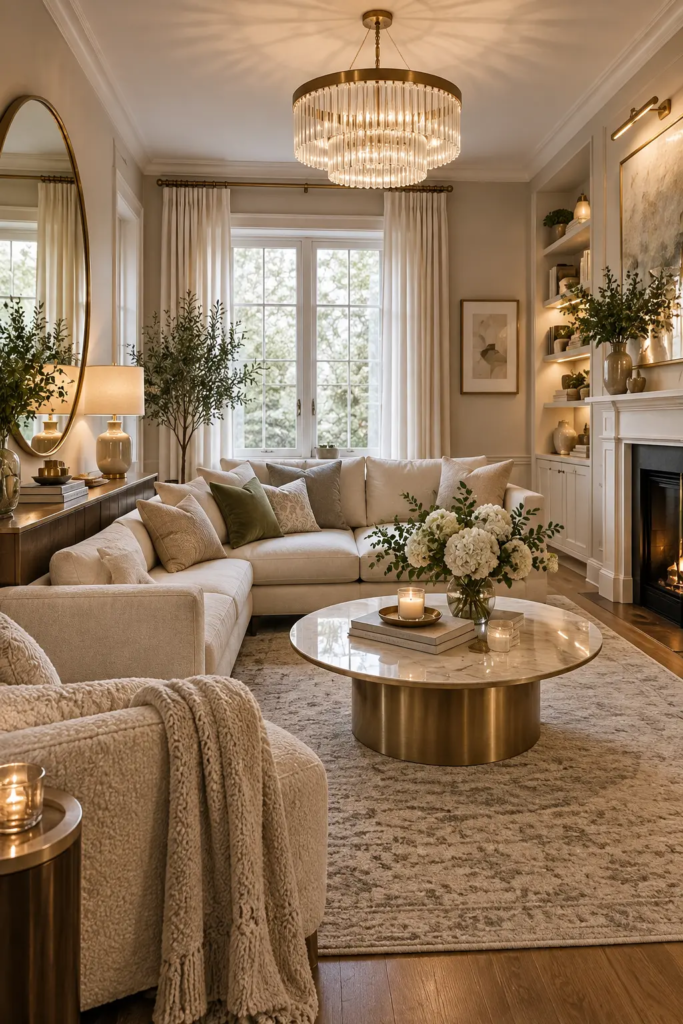
A living room with limited direct sun needs wallpaper chosen for how it handles light, not just its color family. Warm metallics — brushed brass, soft copper, warm gold — and pearlescent finishes reflect what daylight does reach the room back into the space, while flat, deep matte tones (however trendy) tend to flatten and darken a dim room further. Grasscloth is the exception worth naming here: despite being matte and textured, its irregular woven surface catches light unevenly and adds a shifting, alive quality that a flat matte paper can’t replicate.
4. Open-Concept Living/Dining: Wallpaper as a Zone Marker

When your living room bleeds into a dining or kitchen area with no wall to separate them, wallpaper becomes a way to define the living room as its own zone without building anything. Apply it to the wall or walls that structurally bound the seating area — often just two walls of an L-shaped layout — while leaving the dining side painted in a complementary solid. This gives the open floor plan a sense of “rooms” again, purely through a material change underfoot isn’t even needed.
Pro Tip: If your open-concept space has sightlines from the kitchen into the living room, pick a pattern with a color story that pulls one shade from your kitchen cabinetry or backsplash — it keeps the zones feeling like the same home rather than two competing design projects.

- Roll of Wallpaper: Each roll of floral wallpaper measures 17.5in x 393in, covers 48.5 square feet. The blue golden flora…
- Quick & Easy Operation: The self adhesive dark vintage contact paper is very easy to install, no extra glue needed. This…
- Multi-purpose:This DIY boho peel stick wallpaper is an affordable option to refurbish or decorate your home, can be as c…
$39.99
5. Renting or Can’t Damage Walls: Peel-and-Stick, Applied Correctly
Removable peel-and-stick wallpaper has genuinely improved, but its biggest failure point is application, not the product itself. It needs a clean, fully cured wall — freshly painted walls should sit for at least three to four weeks before application, since peel-and-stick adhesive bonds poorly to paint that hasn’t fully off-gassed. Smooth, low-texture walls (not heavy orange-peel or popcorn texture) are essential; texture creates air pockets that show as bubbling within weeks.
Apply it in a single vertical strip at a time, using a plastic smoothing tool from the center of the strip outward, rather than trying to hang a full drop and smooth it after — this is the single most common cause of trapped air and visible seams in DIY peel-and-stick jobs.

- Dimensions – 1 roll – 20.5 inch x 16.5 ft. – 28.19 sq. ft. – 20.5 inch repeat – drop match
- Transform Your Walls – Peel and stick wallpaper is an easy way to revamp any space without any paste or extra adhesive.
- More is More – get more wallpaper per roll with us. RoomMates offers up to twice as much peel and stick wallpaper per ro…
6. Awkward Fireplace Wall or Alcove: Contain the Pattern
A chimney breast, a boxed-in nook beside a fireplace, or an odd angled wall are all places where full-room wallpaper would look chaotic, but a contained application looks intentional. Paper just the alcoves flanking a fireplace, or just the chimney breast itself up to crown height, and leave the surrounding wall painted. A grasscloth or subtle textured paper works especially well here because it reads as a material change rather than “more pattern,” which suits a smaller, contained area.
7. High-Traffic Family Living Room: Choose for Durability First

If your living room absorbs daily foot traffic, kids, or pets, pattern is secondary to construction. Look specifically for vinyl-coated or solid vinyl wallpaper rated as “scrubbable” (not just “washable” — washable typically means a damp cloth wipe only, while scrubbable tolerates actual scrubbing with a mild cleaner). Textured grasscloth and natural fiber papers, however beautiful, are a poor match for this scenario since they stain and can’t be cleaned without visible watermarking.
Pro Tip: Order enough wallpaper to include one full extra roll beyond the calculated amount, and store it flat in a dark closet after the install — dye lots vary between print runs, so a future patch repair from a newly purchased roll may not match, even with the identical product number.

- Polypropylene
- Actual Dimensions: 8 feet 9 inches Width by 12 Feet 4.5 inches Length. Colors and dimensions may vary.
- 2’ x 3’, 2’ x 7’, and 4’ x 5’ rugs work best for entryways and transitional spaces. 5’ x 7’ and 6’ x 9’ rugs work best i…
$270.00
Common Mistakes to Avoid
Skipping the pattern match check. Wallpapers come in straight match, drop match, or random match repeats. A drop match means alternating strips are offset by half the pattern repeat — if you don’t account for this when calculating yardage, you’ll come up short and may not be able to reorder from the same dye lot.
Wallpapering before addressing wall condition. Wallpaper doesn’t hide flaws — it often makes them more visible, since light raking across a seam highlights every dent, nail hole, or uneven patch job beneath it. Skim-coating and sanding first is not optional if your walls have visible texture or damage.
Choosing pattern scale from a small sample swatch. A 4-inch swatch of a large-scale print looks completely different than that same print does across 12 feet of wall. Whenever possible, look at a full-size digital rendering or a larger sample panel before committing.
Ignoring seam placement. A professional installer plans seams to land in corners or behind furniture whenever the pattern allows, rather than dead-center on the most visible wall — ask about this explicitly if you’re hiring out the job.
Budget-Friendly Ways to Get the Look
You don’t need to paper an entire room to get the effect of any of the ideas above. A single accent wall, at roughly 8 feet by 12 feet, typically uses far less wallpaper than a full room and is where most of the visual impact happens anyway. Peel-and-stick options run meaningfully cheaper per roll than traditional pasted paper and skip professional installation costs entirely, provided your walls meet the surface conditions described above. For a lower-commitment test, papering the back panel of an open bookshelf or a small entry nook adjacent to the living room lets you try a bold pattern in a contained, low-stakes area before committing to a full wall.
FAQ
Is wallpaper a good choice for a small living room, or does it make the space feel smaller?
It depends entirely on scale and coverage, not on wallpaper as a category. A large-scale pattern on a single accent wall, paired with solid walls elsewhere, tends to make a small room feel more intentional rather than smaller — it’s an all-four-walls busy pattern that typically causes the shrinking effect.
How much wallpaper do I need for an average living room accent wall?
For a standard 8-foot-tall wall, measure the width in feet and divide by the roll’s coverage width (most standard rolls are 20.5 to 27 inches wide) to estimate strip count, then add 10–15% for pattern matching and waste. Always round up to a full roll rather than ordering the exact calculated amount.
Can I put wallpaper over textured walls?
Lightly textured walls (orbital or light knockdown) can sometimes work with heavier vinyl-coated papers, but anything with popcorn texture, deep knockdown, or visible stucco needs to be skim-coated smooth first — texture will telegraph through the paper and cause peel-and-stick products to fail at the edges.
What’s the difference between traditional pasted wallpaper and peel-and-stick for a living room?
Traditional pasted wallpaper is more durable long-term and handles humidity and wear better, making it a stronger choice for a heavily used living room you plan to keep for years. Peel-and-stick is easier to remove and better suited to rentals or rooms you expect to redecorate again within a few years.
Does wallpaper make a room feel more finished than paint?
Wallpaper adds a layer of pattern, texture, and often light-reflective quality that flat paint can’t replicate, which is why a single papered wall can make an otherwise plain room feel considered. That said, paint executed well with the right undertone can achieve a similarly finished feeling — the two aren’t a strict upgrade/downgrade relationship, just different tools.
The Takeaway
Before you scroll through another wallpaper mood board, name the actual problem your living room has — too small, too dim, too low a ceiling, too exposed to daily wear — and let that narrow your options first. The pattern you fall in love with is much more likely to work in your space if it was chosen to solve something, rather than chosen and then hoped into working.