8 Arabic Style Living Room Ideas That Feel Authentic
An Arabic style living room gets flattened into a caricature more often than most design styles — a few tasseled cushions, a hookah on a side table, and a rug with the “right” pattern, dropped into an otherwise generic room. That’s a theme, not a style, and it reads as costume the moment anyone spends real time in the room.
The actual tradition this style draws from is built on specific, functional choices: low seating meant for long conversation, layered textiles, and pattern used with intention rather than piled on everywhere at once. Here are eight ways to bring that into a living room with the materials and proportions that make it read as considered, not costumed.
Understand What Actually Makes a Room Read as Arabic Style
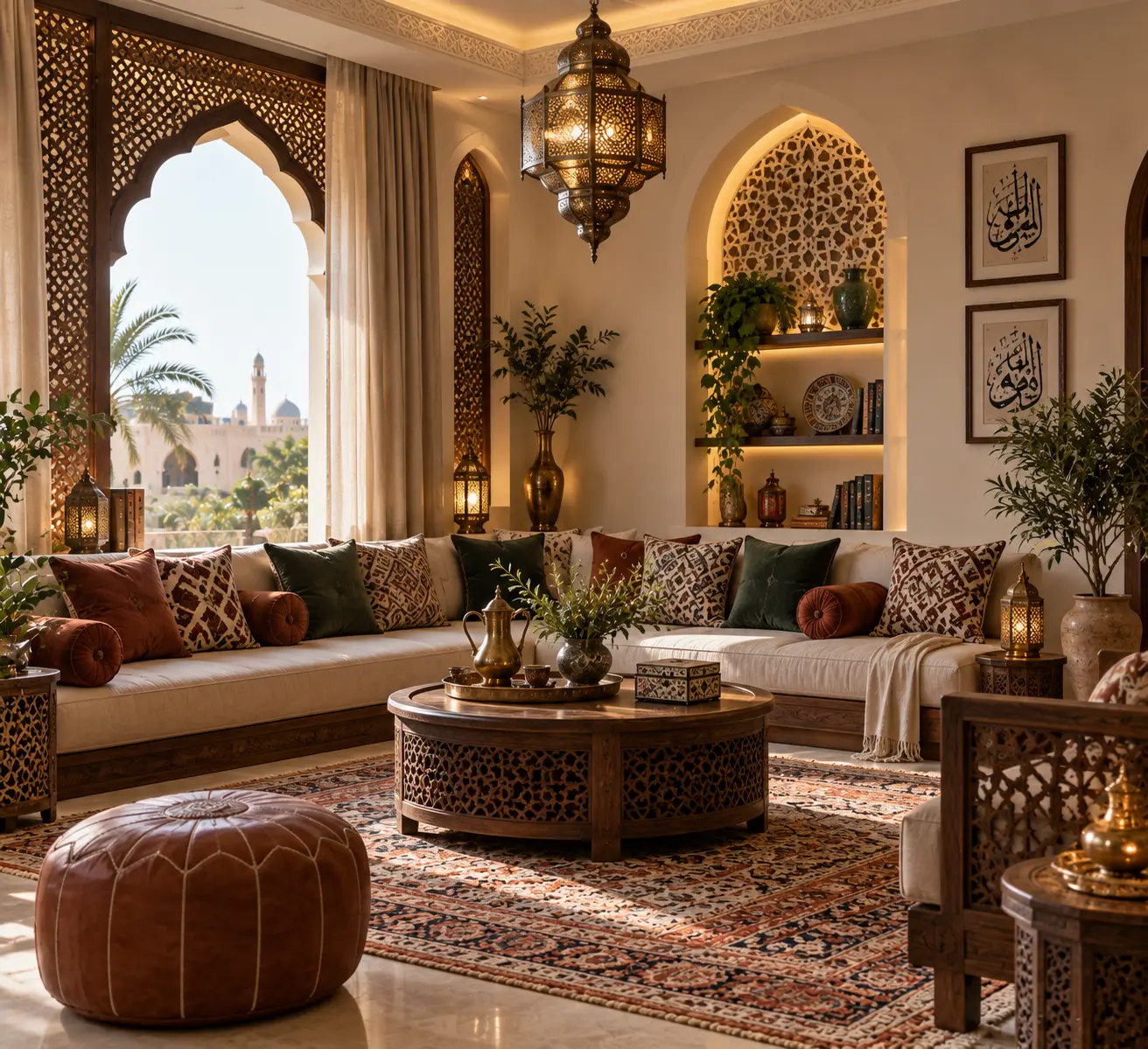
Before buying anything, it helps to know what’s actually doing the work in this style, since it’s rarely the single decorative object people reach for first. Three things carry most of the visual language: low, wraparound seating built for groups rather than a sofa-and-two-chairs arrangement; warm metal accents, almost always brass or aged gold rather than chrome or nickel; and pattern introduced through one or two strong moments — a rug, a wall treatment, a set of cushions — rather than scattered across every surface.
Once you understand that seating layout and metal tone are doing more work than any single accessory, it’s much easier to build a room that feels grounded rather than assembled from a checklist of “Arabic decor” items.
Pro Tip: Start with the seating layout before shopping for anything else. A room with the right low, wraparound seating will read as intentional with fairly minimal styling, while a standard sofa-and-armchair layout won’t fully read as this style no matter how many decorative pieces you add around it.
Build the Room Around Majlis-Style Low Seating
The majlis — low cushioned banquettes or floor seating along the room’s perimeter, facing inward toward a shared center — is the structural core of this style, a genuinely different layout than a Western living room, not just a different sofa. Seating height typically sits around 14 to 18 inches, low enough for sitting cross-legged, with deep, generous cushioning rather than a firm upright sofa cushion.
If a full built-in banquette isn’t practical, a low, deep sectional or floor cushions along two or three walls captures the same wraparound logic without custom carpentry. The goal is a room where seating faces seating, not one where everyone faces a TV.

Layer Rugs Instead of Relying on One
A single rug reads as decoration; two or three layered rugs read as the room’s foundation. A large, neutral base rug anchors the seating area, with one or two smaller, richer patterned rugs layered on top — often at a different orientation — adding depth without every rug carrying equal weight.
Wool and hand-knotted construction hold pattern and color better than a printed or tufted rug, which matters since the rug layer does a lot of the room’s color and pattern work here. If you’re deciding between a bold floor treatment and a bolder living room wall color choice, pick one to lead and let the other stay quieter.
Pro Tip: Layer rugs with a few inches of the base rug visible around the edges of the one on top, rather than matching them edge to edge. The visible border reads as intentional layering rather than a mismatched rug that’s simply too small.

Bring In Geometric Pattern Without Overdoing It
Tile or a Painted Geometric Motif
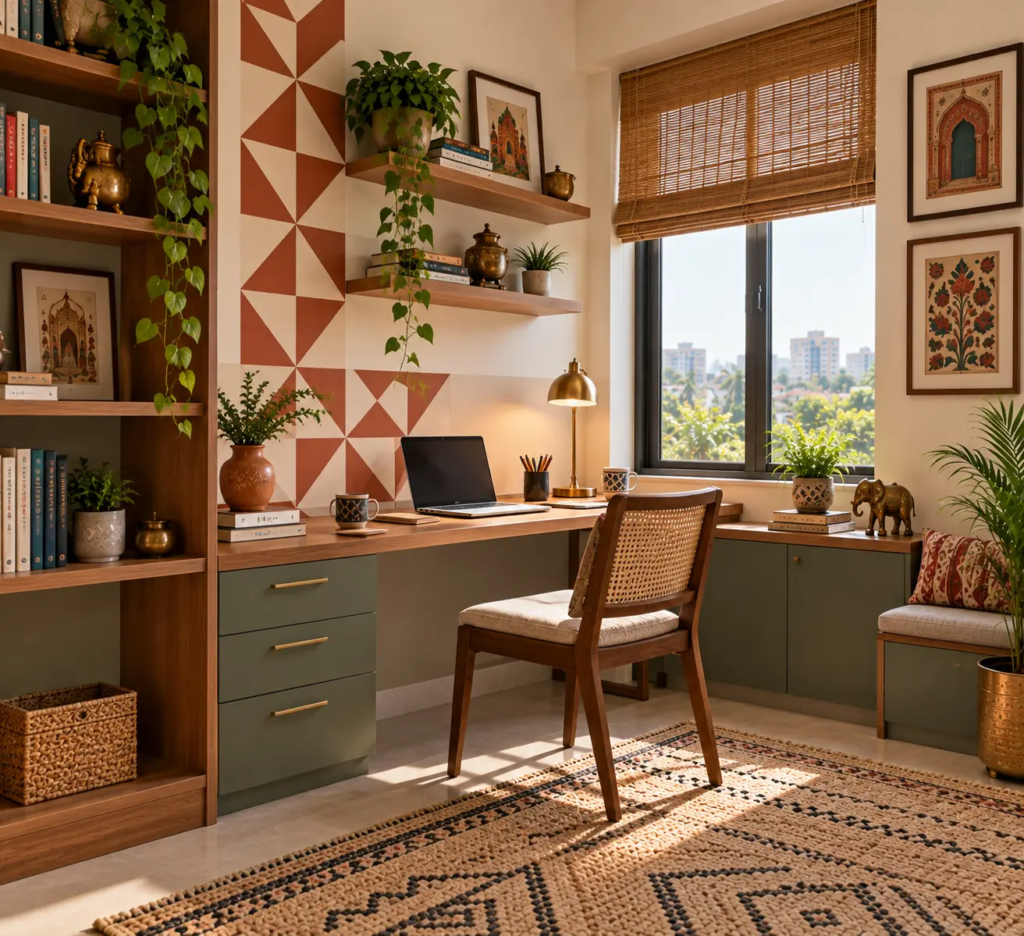
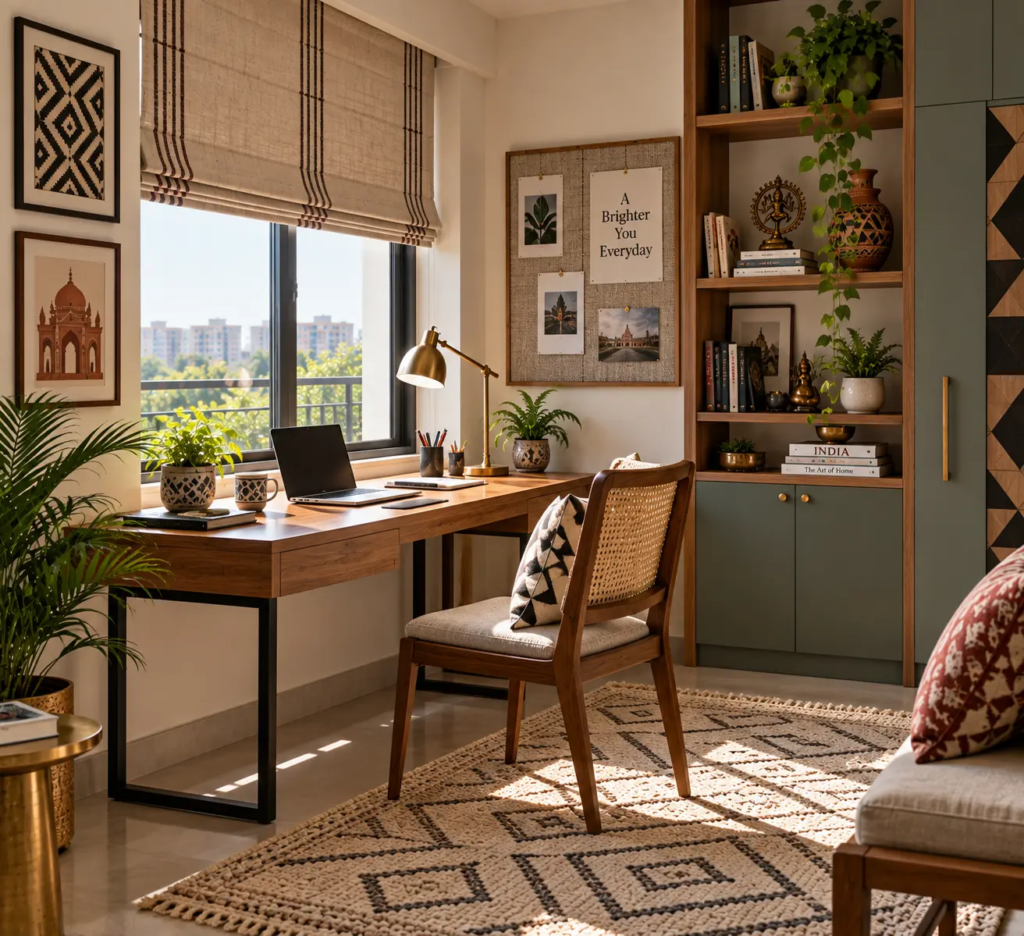
A geometric tile pattern — real tile on a floor or fireplace surround, or a stenciled version on one accent wall — gives the room one strong architectural pattern moment. Keep it to one surface; pattern repeated across floor, wall, and textiles at once competes with itself.
Pattern Through Textiles Instead
If altering tile or walls isn’t an option, put geometric pattern into textiles instead — patterned cushion covers, a printed drapery panel, or a patterned rug border. Same visual language, fully reversible and renter-friendly.
Choose Warm Metal Finishes for Lighting and Accents
Brass, aged brass, and warm gold-toned metal are close to a default in this style: cool metals like chrome and brushed nickel read as clinical against the deep, saturated colors and textiles this style typically uses. A pierced-metal lantern-style pendant or a cluster of brass sconces does double duty, since the metalwork itself is decorative even unlit.
Metal side tables and tray tables in the same warm finish reinforce the look without a full furniture overhaul, and they’re an easy secondhand find, since brass ages well and doesn’t show wear the way upholstery does.
Pair Deep, Saturated Color With a Quieter Base
Jewel tones — emerald, sapphire, ruby, deep amber — are core to this style’s color language, but they read as rich rather than overwhelming only when set against a calmer base: a warm white, sand, or plaster-toned wall rather than another saturated color. The contrast between quiet walls and rich textiles is what makes the color feel intentional instead of chaotic.
If you’re set on painting the walls a deeper tone too, keep the pattern and color saturation in the textiles a notch lower than you would against a neutral wall, since two loud elements compete rather than reinforce each other.
Pro Tip: Test jewel-toned fabric swatches against your wall color in the room’s evening lighting, not just daylight. Deep colors like emerald and sapphire shift more under warm bulb light than lighter colors do, and a swatch that looks perfect at noon can read almost black by lamp light.
Echo Arched Lines Through Mirrors, Shelving, or Doorways
Arched forms — in doorways, mirror frames, niche shelving, or a single arched panel behind the seating — are a recurring architectural signature in this style, and one of the easier details to add without structural renovation. An arched mirror or a piece of arched millwork behind the majlis seating does much of the same visual work a full architectural arch would, at a fraction of the cost.
This kind of architectural detailing is a similar decision to the one covered in guides on elegant, more traditional living room design — the arch doesn’t need to dominate the room to read clearly; one well-placed instance is usually enough.

Anchor the Seating With a Low Table
A low brass, wood, or mother-of-pearl-inlaid table at the center of the seating arrangement does the same job a coffee table does in a Western layout, but sized and positioned for a room where people sit lower and closer to the floor. Round or hexagonal tray tables, sometimes clustered in twos or threes at slightly different heights, work especially well with a majlis-style layout since they can be moved closer to whoever’s using them.
Common Mistakes That Undercut an Arabic Style Living Room
Treating it as an accessory checklist. A standard Western sofa layout with a few patterned pillows and a brass lamp added on top reads as decorated, not designed. The seating arrangement itself needs to change for the style to read clearly.
Overloading pattern on every surface. Geometric pattern on the floor, the walls, and every textile at once competes with itself. One or two strong pattern moments read as intentional; five cancel each other out.
Mixing cool and warm metals in the same sightline. A brass pendant next to chrome hardware or a nickel lamp base undercuts the warmth the rest of the room is built around, even if each piece looks fine on its own.
Skipping textural variety in favor of pattern alone. A room can have plenty of pattern and still feel flat if every fabric has the same sheen and weight. Mixing velvet, embroidered textiles, and a woven or wool rug adds the depth pattern alone doesn’t provide.
Budget-Friendly Ways to Build the Look
- Seating: Floor cushions and bolsters along existing walls approximate a majlis arrangement for a fraction of the cost of custom built-in banquette seating, and they’re easy to store or rearrange.
- Metal accents: Secondhand brass pieces — trays, small tables, candle holders — are widely available and often better priced than new reproductions, since brass ages well and isn’t judged harshly for wear.
- Pattern: A single patterned rug or a set of patterned cushion covers delivers most of the visual effect of a full architectural pattern treatment without the cost of tile work.
- Color: A gallon of deep jewel-toned paint on one accent wall or alcove costs far less than sourcing rich-toned upholstery for a full seating arrangement, and can anchor the room’s color story on its own.
For curtains as another layer of texture, it’s worth looking at living room curtain ideas with an eye toward heavier, richer fabrics rather than the lighter linen panels that suit a more minimal room.
Pro Tip: If building this look gradually, start with textiles and metal accents before committing to a full seating overhaul. Cushions, a rug, and a few brass pieces establish the visual language clearly enough to live with for a while before investing in custom or built-in seating.
Frequently Asked Questions
Do I need custom furniture to get a real majlis-style layout? No — a low, deep sectional or floor cushions arranged along two or three walls captures the wraparound, conversation-focused seating logic without built-in carpentry. Custom banquette seating is an option for a more permanent version, but not a requirement.
What colors work best for an Arabic style living room? Jewel tones like emerald, sapphire, and deep amber are the traditional core, typically set against a calmer neutral wall in warm white, sand, or plaster tones. The contrast between the quiet base and rich textiles keeps the color feeling intentional rather than overwhelming.
Is this style only achievable with expensive materials? No — brass accents, patterned textiles, and layered rugs can be sourced secondhand or at a range of price points, and the seating layout (which does more visual work than any single object) can be built with floor cushions rather than custom furniture.
How do I avoid the room feeling like a theme rather than a real design style? Focus on the seating layout and the relationship between pattern, color, and metal tone rather than treating individual decorative objects as the goal. A room built around the right proportions reads as designed even with minimal accessories.
Can this style work in a small living room? Yes, though it benefits from editing rather than compressing every element. A smaller room does better with one strong pattern moment, one metal tone, and a simpler layered-rug approach than trying to fit every element in at a reduced scale.
An Arabic Style Living Room That Reads as Designed, Not Decorated
An Arabic style living room comes together when the seating layout, the metal tone, and the pattern choices work together rather than being treated as separate shopping categories. Start with how the room is arranged for sitting and talking, choose one or two strong pattern and color moments instead of spreading them everywhere, and let brass and layered textiles carry the warmth. Done that way, the room reads as a real, livable version of the style instead of a theme applied on top of a generic layout.