The Japandi Dining Room That Doesn’t Feel Cold
Japandi gets recommended constantly for dining rooms, and then a lot of people end up with a room that looks more like a furniture catalog than a place they’d want to eat dinner in. The style leans on restraint — clean lines, muted palettes, very little on the walls — and restraint is exactly what tips over into “empty” when it’s applied without enough warmth to balance it.
The dining room is a hard test case for this. Unlike a bedroom or a reading nook, it needs to hold up under daily use: kids doing homework at the table, mismatched dishes, a chair pulled out at an angle. A dining room that’s too pared-back reads as precious the moment real life happens in it. So this guide isn’t a general “what is japandi” primer — it’s specifically about how to keep the warmth in, room by room, so the space still feels like yours on a Tuesday night, not just in photos.
The Core Framework: Balance, Not Minimalism
Japandi is often described as “Japanese minimalism meets Scandinavian coziness,” which is accurate but not that useful on its own. The working principle that actually helps when you’re furnishing a room is this: every cool, hard-edged element needs a warm, soft-edged element to sit next to it, or the room tips into austere rather than calm.
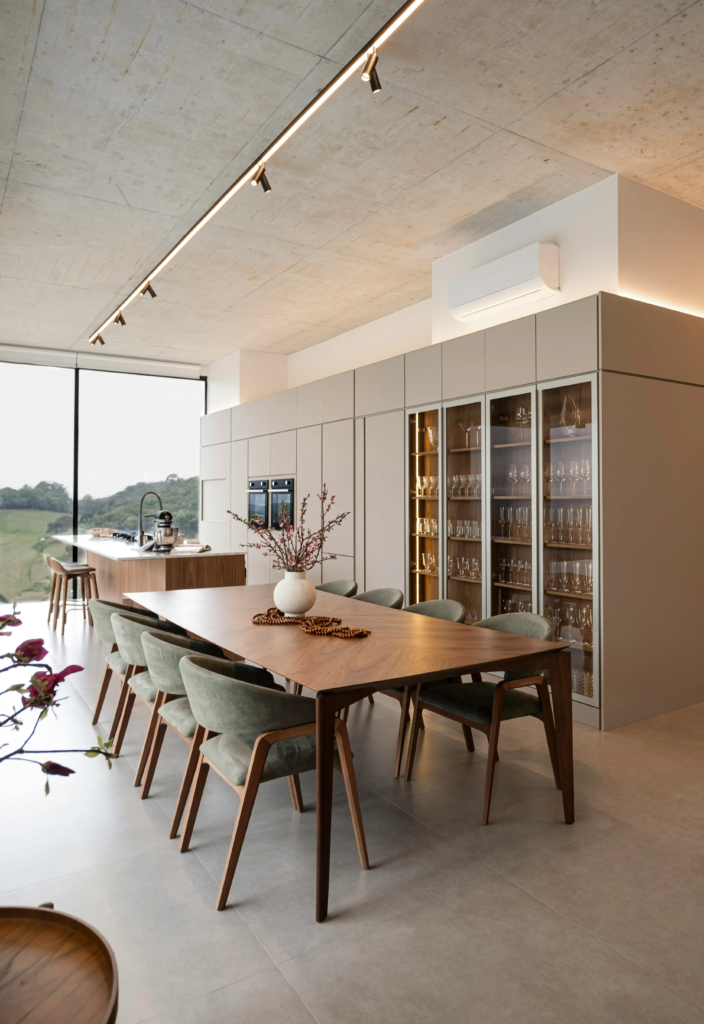
Concretely, that means a matte black metal light fixture gets paired with a natural wood table, not a second metal or glass piece. A low, straight-lined dining bench gets a woven or bouclé seat cushion, not a bare wood or leather one. This isn’t a strict 50/50 split — most Japandi rooms lean maybe 60% warm, natural materials and 40% cooler, structured ones — but the moment a room is more than about 70% hard surfaces (glass, black metal, bare concrete-look flooring), it stops reading as Japandi and starts reading as cold minimalism with a wood table thrown in.
Choosing a Table That Anchors the Room Without Overpowering
Pro Tip: If you’re not sure whether a room has enough warmth, take a photo of it in black and white. Warm, textured materials (linen, unfinished wood, wool) will still read as visually “soft” in grayscale, while glossy or hard-edged pieces will look stark — it’s a fast way to check balance without relying on color perception, which is easy to fool yourself on.
The dining table is doing more visual work in a Japandi room than in most other styles, because there’s less going on around it to distract from it. Low-profile tables with rounded or gently tapered legs (think 28–29 inches tall rather than a standard 30-inch table) read as more Japandi-aligned because the lower sightline is part of the aesthetic’s Japanese half — it echoes low seating traditions even in a room with regular chairs.
Solid wood is worth prioritizing over veneer here specifically because Japandi tables are usually left with minimal styling, which means the material itself is on display rather than hidden under a runner and centerpiece. Ash, oak, and walnut all work, but they read differently: ash and oak stay light and keep a room feeling more Scandinavian, while walnut pulls the room toward a warmer, more traditionally Japanese palette.
Round vs. Rectangular Tables in Small Rooms
In a dining room under roughly 120 square feet, a round table (42–48 inches) usually works better than a rectangular one, not just because it seats comfortably without corners jutting into a walkway, but because rounded forms are part of the softening logic that keeps the whole room from feeling too rigid. If you need to seat six or more regularly, an oval table splits the difference — it keeps the same soft-edged effect while giving you the extra length a round table can’t.
Seating: Where Most of the Warmth Should Live
If you only have budget or energy to focus warmth in one part of the room, put it in the seating. Chairs and benches touch the body directly, which means their material has an outsized effect on how “cozy” a room feels compared to, say, a wood floor you’re only looking at.
Mixing chair types is genuinely on-brand for Japandi rather than a compromise — a bench on one side of the table paired with two or three chairs on the other breaks up the uniformity that makes a room feel like a showroom set. Look for woven rush or cane seats, boucle or wool upholstery, and avoid a full set of matching leather or vinyl chairs, which push the room toward a colder, more corporate feel even if the frame material is right.
Lighting That Does the Warming Work Color Can’t
Japandi palettes are intentionally muted — oatmeal, clay, soft charcoal, unbleached linen — which means you can’t lean on saturated color to add warmth the way you could in a maximalist room. Lighting has to do that job instead.
Warm-white bulbs (2700K, not 3000K or daylight) are non-negotiable in a Japandi dining room; a cooler bulb temperature will fight against every warm material choice you’ve made. A single woven pendant — rattan, paper, or bamboo — hung at 30–34 inches above the table does more to establish the room’s character than almost any other single piece, because it’s usually the first thing eyes land on when entering the room.
Natural light matters just as much here. If your dining room has a window, a sheer linen curtain rather than a blackout or heavy drape lets diffused daylight in without the harsh, cool cast of unfiltered sun — which especially matters at midday, when unfiltered light can make a pale wood table look almost gray instead of warm.
Layering Texture Without Adding Clutter
The instinct in a minimal-leaning room is to add objects for warmth — a vase here, a runner there — but Japandi actually asks you to add texture instead of objects wherever possible, because visual clutter undoes the calm the style is built around. A linen table runner, a jute or wool rug under the table, and one ceramic piece left permanently on a sideboard will do more than five small decorative objects scattered around.
The rug matters more than people expect in a dining room specifically because it’s one of the largest surfaces in the room and it’s underfoot rather than overhead, so it sets the tone before anyone even sits down. A flatweave jute or wool rug, sized so all four chair legs stay on it even when pulled out, keeps the room grounded without adding visual noise the way a patterned rug would.
Common Mistakes That Push Japandi Into “Cold Minimalism”
Going all-neutral with no material variation. A room where every surface is a similar shade of beige or gray, regardless of material, ends up flat rather than calm. Vary the material even when you keep the color palette tight — matte wood, woven fiber, and soft textile in the same tonal family still create visual depth that solid color alone can’t.
Leaving walls completely bare. Japandi doesn’t mean no wall decor, it means restrained wall decor. One piece — a textured ceramic plate, an abstract linen wall hanging, a single framed piece of unglazed pottery — keeps a wall from reading as unfinished rather than intentional.
Choosing a glossy or high-shine finish anywhere. Lacquered wood, glass tabletops, and glossy ceramic all reflect light in a way that reads as sleek-modern rather than Japandi-warm. Matte and satin finishes are correct almost everywhere in this style.
Over-styling the table when it’s not in use. A table set with a full centerpiece, candles, and a runner every single day starts to look staged rather than lived-in. Leave the table mostly clear between meals, with just one grounding object — a bowl, a small plant — so it still looks intentional but not performed.
Pro Tip: If a room feels flat even after adding wood and textile, check your floor. A pale or gray-toned floor under warm furniture creates a visual disconnect that no amount of styling fixes — a jute or wool rug in a warmer tone than the floor itself will do more to fix that mismatch than swapping out furniture pieces.
Budget-Friendly Ways to Build a Japandi Dining Room
You don’t need to furnish this room all at once, and you shouldn’t — Japandi rooms actually look better built up slowly, since a slightly imperfect, mixed-source collection of pieces reads as more authentic than a matched furniture set bought in one trip. Start with the table and one lighting fixture, since those two pieces set the tone for everything else.
Secondhand solid wood tables are common at estate sales and marketplace listings, often for less than a comparable new veneer table, and solid wood refinishes well if the surface has minor wear. For seating, mismatched secondhand chairs reupholstered in a consistent linen or boucle fabric cost less than buying a matching set new, and the slight variation in frame shape is part of the aesthetic rather than a flaw to hide.
FAQ
What colors work best in a japandi dining room? Stick to a narrow palette of warm neutrals — oatmeal, clay, soft charcoal, unbleached linen — rather than pure white or true black, which read as too stark for the style. Small amounts of deep green or muted terracotta work as accent colors if you want something beyond neutrals.
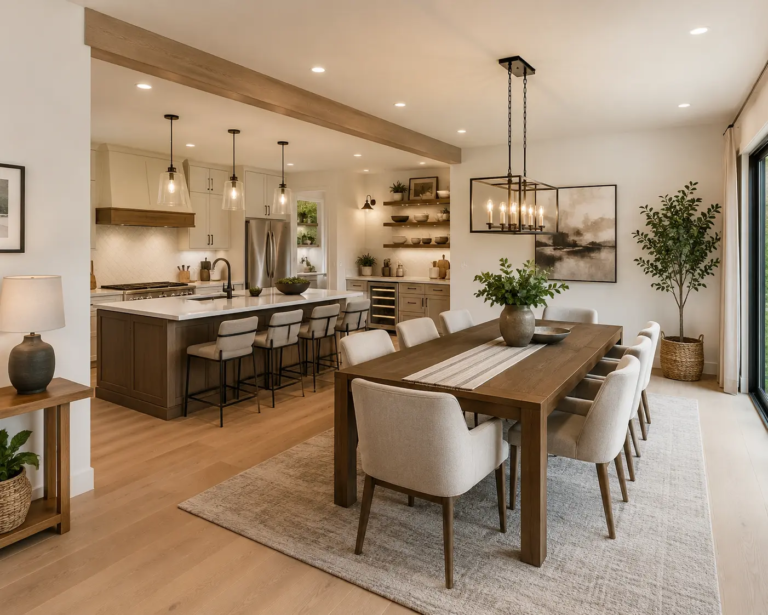
Can a japandi dining room work in an open-concept space? Yes, and it often works especially well, since the muted palette transitions smoothly between a kitchen and dining area without needing a hard visual break. The main adjustment is keeping cabinetry and dining furniture in the same general warmth level so one zone doesn’t read as colder than the other.
Is japandi too minimal for a family with kids? Not if you prioritize durable, easy-to-clean materials in your warm-material choices — a performance linen blend or a wipeable wool blend holds up to daily use better than delicate natural fiber. The style’s low-clutter approach can actually make daily cleanup easier, since there are fewer small decorative objects to work around.
What’s the difference between japandi and Scandinavian dining room style? Scandinavian design leans lighter and brighter overall, often with more white and pale wood, while japandi pulls in darker woods, more matte black or bronze metal accents, and a slightly more grounded, lower-profile furniture silhouette influenced by Japanese design. Japandi also tends to use fewer decorative objects than a typical Scandinavian room.
Do I need a pendant light for a japandi dining room to work? No, but overhead lighting temperature and placement matter more in this style than in most others because there’s so little color and pattern to distract from a harsh light source. A warm-toned pendant is the easiest single upgrade, but a warm-bulb floor lamp or wall sconce can achieve the same effect if a pendant isn’t possible.
The Practical Takeaway
A japandi dining room stays warm not because of any single statement piece, but because warmth gets built into every layer — the wood tone, the seat material, the bulb temperature, the rug underfoot. If a room you’re working on starts to feel more like a showroom than somewhere you’d actually sit down for dinner, the fix is almost never to add more objects. It’s to check whether the materials you already have are warm enough to earn the restraint around them.