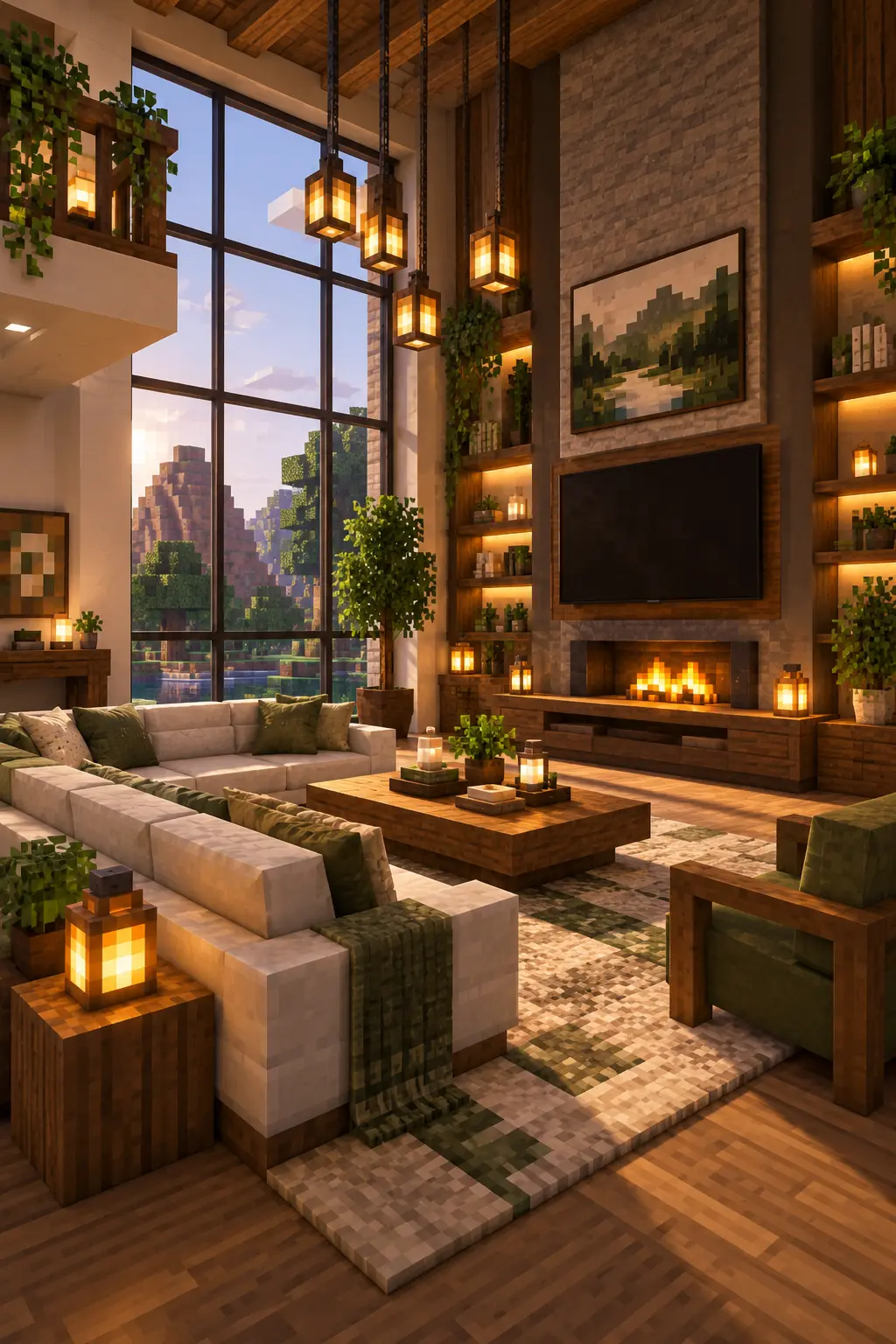
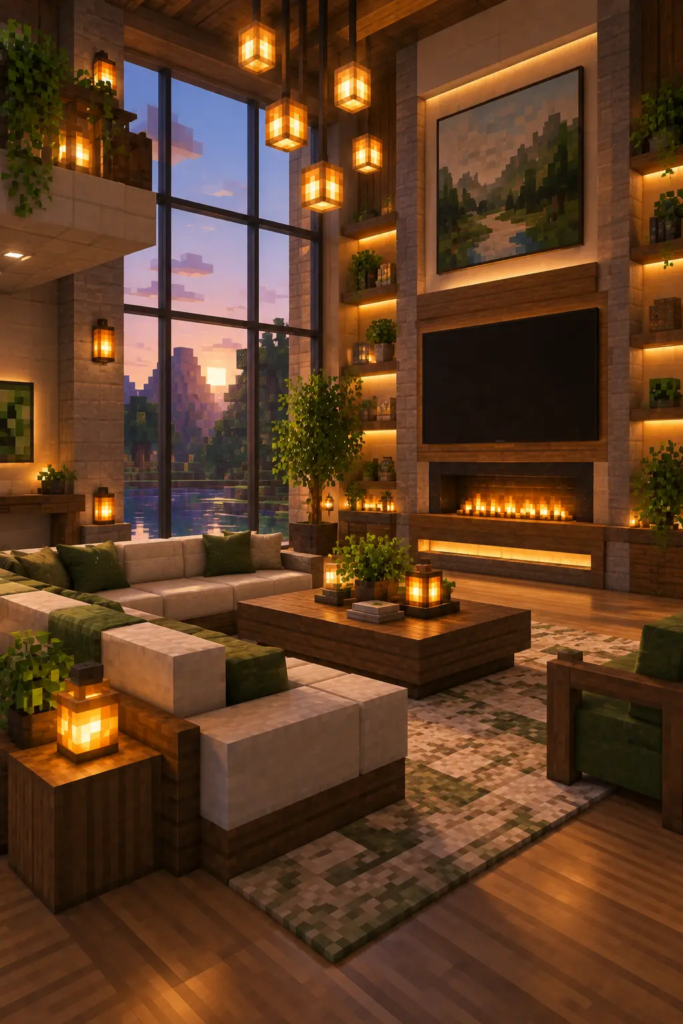
Search “Minecraft living room ideas” and you mostly get two extremes: full pixel-block party rooms with foam creeper heads and green-and-brown everything, or nothing usable at all for an actual shared family space. Neither helps if what you’re really after is a living room your Minecraft-obsessed kid feels is partly theirs, that doesn’t read as a themed birthday party five years past its expiration date, and that you can still host guests in without explaining the decor choices.
The workable version pulls from Minecraft’s actual visual language — its palette, its geometry, its materials — rather than reproducing the game literally. That distinction is what separates a living room that ages well from one you’ll be redoing in eighteen months.
The Subtle-Reference Framework: Palette and Geometry Over Literal Pixels
Minecraft’s world is built from a surprisingly sophisticated, muted palette — mossy greens, warm oak browns, slate greys, deep blues — dressed up by the game’s blocky, low-resolution aesthetic. Once you separate those two things, the path forward gets clearer: borrow the color story and the geometric, squared-off shapes, and leave the literal 8-bit pixel graphics for a single small accent rather than the whole room. A living room built this way reads as “this family likes games and design” rather than “we built a movie set,” and it holds up whether your kid is still deep into Minecraft next year or has moved on to something else entirely.
Pro Tip: Before buying anything new, pull five to six screenshots from actual in-game biomes your kid plays in most (a birch forest, a mesa, an ocean shore) rather than generic “Minecraft colors” — the real in-game palettes are more muted and more usable in a living room than the saturated marketing artwork most searches turn up.
https://pixabay.com
Pull the Color Palette from Minecraft’s Biomes, Not Its Blocks
Rather than the bright primary green and brown most people associate with the game, look at what a specific biome actually looks like: a birch forest gives you soft sage, warm cream bark tones, and dove grey; a mesa gives you terracotta, rust, and sandy tan. Picking one biome’s palette rather than “Minecraft green” generally gives the room a coherent, sophisticated color story instead of a costume-department one, and it’s a genuinely fun project to do with your kid — let them pick the biome, you translate it into paint chips and fabric swatches.
Use Geometric, Blocky Shapes in Furniture and Shelving
Minecraft’s world is built entirely from cubes, and you can echo that visually through furniture silhouette without it reading as a costume. A modular cube-shaped storage ottoman, square-edged open shelving instead of curved units, or a coffee table with a clean, blocky base all reference the game’s geometry in a way that also happens to be a solid, current furniture trend on its own. The key is picking pieces that would look intentional in a living room with zero gaming context — if a piece only makes sense as a Minecraft reference, it’s probably too literal.
Swap Literal Pixel Art for Abstracted Grid Wall Art
Actual pixel-art prints of Minecraft characters read as a kid’s bedroom, not a shared family room — but the underlying grid structure behind pixel art translates surprisingly well into abstract wall art. A framed geometric grid print in your chosen biome’s palette, or a set of small square canvases arranged in a grid pattern on the wall, nods to the same visual logic without needing anyone to recognize the game to appreciate it. Save the one literal, recognizable Minecraft piece — a favorite in-game screenshot printed and framed, say — for a single small frame rather than the room’s main art statement.
Pro Tip: If you’re framing an actual in-game screenshot, take it in creative mode with render distance turned up and shaders or a resource pack that softens the block edges slightly — the default low-render, harsh-pixel screenshot most people grab looks noticeably worse printed and framed at any real size.
Create a Dedicated Gaming Corner Instead of Theming the Whole Room
Rather than spreading the Minecraft references evenly across the whole living room, concentrate them in one defined zone — a corner with the gaming console or PC setup, a comfortable chair, and closer storage for controllers and peripherals. This solves two problems at once: it keeps the rest of the room flexible and adult-friendly, and it gives your kid a space that feels genuinely theirs within the shared room, which usually matters more to them than the theme being visible everywhere.
https://pixabay.com
Use Lighting to Reference Torches and Glowstone Without Looking Costume-y
Minecraft’s in-game lighting — warm torch glow, the golden light of glowstone — translates well into real lighting choices without needing an actual prop torch mounted on the wall. A warm 2200–2700K bulb in a wall sconce placed at a similar height to where an in-game torch would sit gives a subtle nod that most guests won’t consciously register as a game reference at all, just as a warm, intentional lighting choice. Save any literal light-up decor (an actual glowstone-style lamp, for instance) for the gaming corner rather than the room’s main lighting.
Bring in Wood and Stone Textures That Echo the Game’s Materials
Minecraft’s world is built from recognizable, named materials — oak planks, cobblestone, stripped birch — and real versions of those same materials do a lot of the referencing work without needing any graphic imagery at all. A stacked-stone accent wall, exposed wood shelving with visible grain, or a coffee table with a rough, unfinished-looking wood top all connect to the game’s material logic in a way that reads as intentional, textural design in any context.
[IMAGE: A stacked natural-stone accent wall behind an open wood shelving unit, textures echoing the game’s cobblestone and plank blocks]
Pro Tip: If a full stone accent wall isn’t in the budget, peel-and-stick stacked-stone panels applied to a single small section — behind a console table or TV stand rather than a full wall — deliver most of the visual texture at a fraction of the cost and are renter-friendly to remove later.
https://pixabay.com
Let Building-Block Displays Do the Playful Work
A dedicated display shelf for LEGO builds, Minecraft figures, or building-block creations gives your kid’s interests a visible, celebrated place in the room without those items scattered across every surface. Floating shelves at a height your kid can actually reach and rearrange keep the display feeling current rather than static, and it doubles as a rotating art piece — swap what’s displayed every few months and the room stays fresh without any new purchases.
https://images.unsplash.com
Balance Kid Input With Furniture That Survives the Phase
The single biggest risk with any interest-driven room refresh is spending real money on pieces so specific to one game that they become dated the moment the interest shifts. Split your budget deliberately: let your kid have real input on the smaller, cheaper, easily swapped elements — throw pillows, the display shelf contents, one piece of wall art — while keeping the larger investments (sofa, rug, the actual paint color) in the more neutral, biome-inspired palette that works regardless of what game holds their attention next year.
https://images.unsplash.com
Common Mistakes to Avoid
The most common mistake is going literal across the whole room — full pixel-print wallpaper, character cutouts, primary-color everything — which reads as a themed party rather than a lived-in family space and rarely survives a kid’s shifting interests for long. A second mistake is putting all the budget into decor items and none into durability, when a Minecraft-loving household is often also a hard-on-furniture household; stain-resistant fabric and a washable rug matter more here than in a purely decorative room. Third, letting the theme creep into every surface instead of concentrating it in one defined gaming corner, which makes the whole room feel busier than it needs to and harder to keep looking put-together for guests.
Budget-Friendly Minecraft Living Room Ideas
On a lower budget (under $150), start with the palette shift — new throw pillows and a throw blanket in your chosen biome’s colors, plus one framed piece of grid-based or actual screenshot art, changes the room’s feel more than you’d expect for the price. At a mid budget ($150–$500), a floating display shelf system and peel-and-stick stone panel accent give real texture and a dedicated display space without a full renovation. At a higher budget ($500+), prioritize the furniture that needs to survive daily use — a stain-resistant sofa and a washable geometric-pattern rug — since that’s where a gaming-heavy household actually needs the investment, with the decor layered on top rather than the other way around.
[IMAGE: Three-tier budget flat-lay — biome-toned pillows and framed art, then a floating display shelf, then a stain-resistant sofa swatch and washable rug sample]
FAQ
Will a Minecraft-themed living room look dated once my kid moves on to a different game? It depends heavily on how literal you go — a room built around actual Minecraft graphics and character imagery will feel dated quickly, while one built around a muted biome palette and geometric shapes will simply read as a well-designed room, no explanation needed. Keeping the game-specific elements confined to small, easily swapped items (a display shelf, one framed piece) protects the bigger investments from becoming irrelevant.
How do I get my kid excited about a subtle version instead of a full-theme room? Involve them directly in choosing the in-game biome or screenshot the palette comes from, and give them a defined gaming corner that’s visibly theirs, with real say over the display shelf contents. Kids often care less about the room looking literally like Minecraft than about having a genuine, respected space for their interest — the subtle version usually satisfies that as well as the literal one.
Can this work in a small living room, or does it need a dedicated playroom? A defined gaming corner works in a smaller room as long as you keep it to a clearly bounded zone — a chair, a small side table, and shelving in one area — rather than letting gaming furniture spread across the whole footprint. Vertical storage (floating shelves rather than floor units) is especially useful in a small space, since it keeps the display visible without eating into floor space.
What’s the most durable flooring or rug choice for a household that games a lot? A low-pile, washable rug in a performance fabric (look for polypropylene or a stain-treated wool blend) holds up far better under snack spills and controller drops than a plush high-pile rug, and it’s easier to spot-clean without professional help. Darker or patterned rugs also hide wear and minor stains better than a solid light color in a high-traffic gaming zone.
Does this style work for older kids and teens too, or is it mainly for younger children? The muted, geometric approach actually works better for older kids and teens than a literal theme would, since it doesn’t read as babyish the way character cutouts or bright primary colors tend to. Teens especially tend to prefer their interests reflected through color and shape rather than literal imagery, which lines up well with this whole approach.
The Real Takeaway
The best Minecraft living room ideas borrow the game’s palette, geometry, and materials rather than its literal imagery, which is exactly what lets the room feel personal to your kid today without needing a redo when their interests shift. Start with the biome-based color palette and one defined gaming corner, and let everything else — furniture, lighting, texture — build outward from those two decisions rather than trying to reference the game on every surface at once.
Most boho dining rooms fail the same way: a rattan chair, a macrame wall hanging, a printed runner, and a jute rug all land in one room and read less “collected over time” and more “everything from the sale rack at once.” The pieces aren’t wrong. Boho is a style built on layering, and layering…
The dining rooms in cottage photos come with help: a low beamed ceiling, a deep-set window, walls that bow slightly where the plaster has settled. Yours is more likely a rectangle with an 8-foot flat ceiling, a builder-grade window and perfectly straight drywall. That’s workable. The cottage feeling comes from a handful of decisions about…
Black Living Room Decor That Doesn’t Feel Like a Cave The photos that come up when you search black living room decor almost always show the same thing: a bright, south-facing room with floor-to-ceiling windows, where black furniture and black walls read as moody and intentional because there’s so much daylight bouncing around to balance…
If your dining room doesn’t actually have four walls, most “modern dining room” inspiration doesn’t quite fit. It assumes a defined room with its own paint color and light fixture doing all the visual work. But if your dining space flows into the kitchen and living room — true for most homes built or renovated…
Cottage Dining Room Ideas for Small, Older Rooms That Still Feel Grown-Up A cottage dining room looks effortless in photos — a long wood table, mismatched chairs, a window full of soft light — but most of those photos are shot in rooms with 9-foot ceilings and oversized windows that don’t reflect what a real…
The bathroom is often one of the most overlooked spaces in a home when it comes to interior design. While living rooms, bedrooms, and kitchens usually receive the most attention, a well-designed bathroom can significantly enhance your daily routine and create a relaxing retreat. Whether you’re planning a complete renovation or simply looking to refresh…