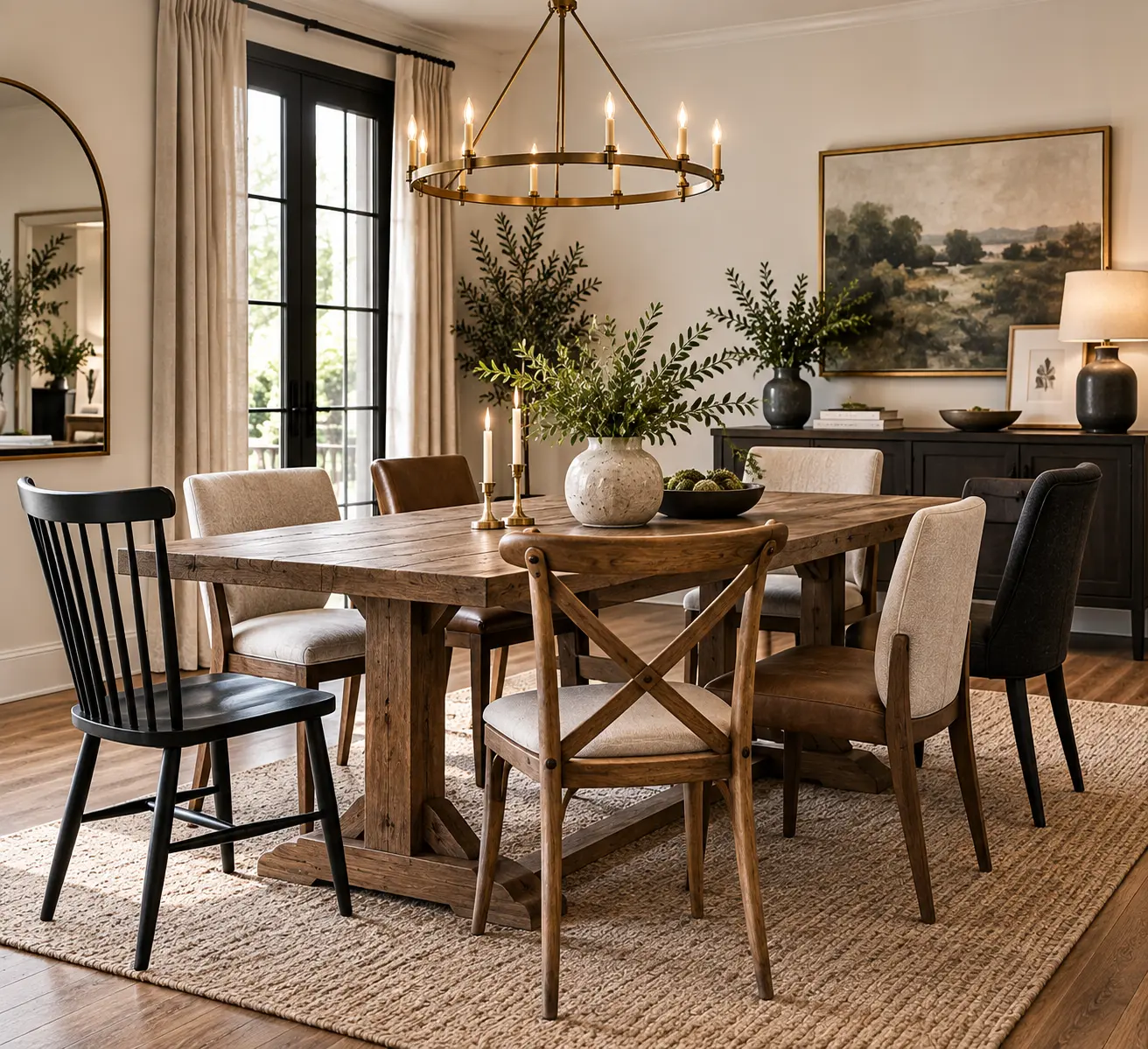
Cottage Dining Room Ideas for Small, Older Rooms That Still Feel Grown-Up
A cottage dining room looks effortless in photos — a long wood table, mismatched chairs, a window full of soft light — but most of those photos are shot in rooms with 9-foot ceilings and oversized windows that don’t reflect what a real cottage, or a real older home built to look like one, actually offers. If your dining room has a low ceiling, one small window, and barely enough square footage for a table and six chairs, the aspirational version of this style can feel unreachable, or worse, like it’ll make an already tight room feel smaller and darker.
The other risk with cottage style specifically is tipping into costume territory: too much gingham, too many roosters, a room that reads as a theme rather than a place someone actually lives. Every idea below is chosen for a real, modestly sized cottage-style room — the kind with real architectural constraints — and aimed at keeping the look collected and lived-in rather than staged or saccharine.
The Foundation: Pick Two Signatures, Let the Room Breathe
Cottage style pulls from a wide well of signatures: mismatched vintage chairs, gingham or small floral textiles, painted or whitewashed wood, open shelving with collected dishware, dried or fresh florals, and warm brass or wrought iron hardware. Using all of them in a small room is what produces the theme-park effect — there’s no visual rest for the eye, and in a room that’s already tight on square footage, that busyness reads as clutter rather than charm.
The rooms that work well in a modest space commit to two, maybe three, of these signatures as the room’s identity and let everything else stay plain. A room built around mismatched vintage chairs and painted wood, with no pattern anywhere else, still reads clearly as cottage. Adding gingham curtains, a floral rug, and a rooster-print tablecloth on top of that same room is what pushes it into overwhelm, especially at a smaller scale where every element takes up a larger percentage of what you actually see.
If you want a broader look at the softer, more romantic end of this style once you’ve settled the basics, INTERNAL LINK: cottagecore dining room ideas covers the cozier, more layered version of the same aesthetic.
[IMAGE: A small cottage dining room with a whitewashed wood table, three mismatched vintage wood chairs, plain white walls, and a single small vase of dried flowers as the only decorative accent]
1. Mismatched Chairs, One Shared Element
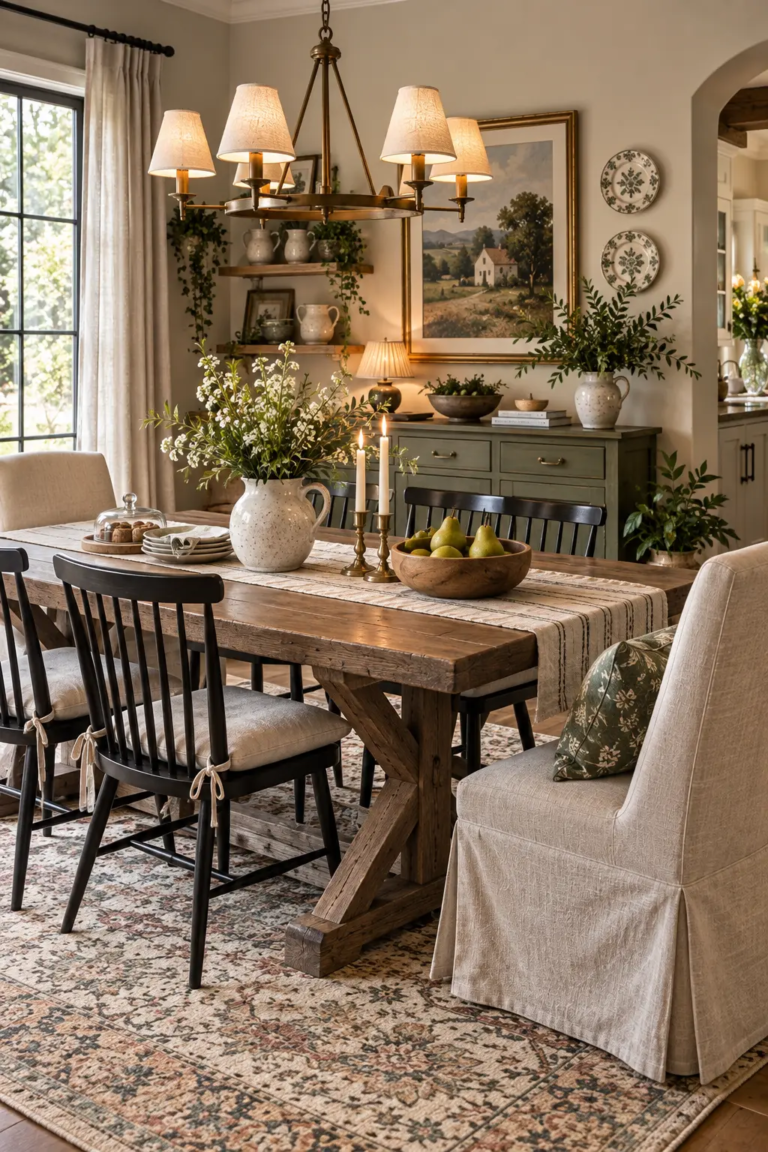
Vintage or vintage-style dining chairs that don’t match each other are one of cottage style’s clearest signatures, and they’re genuinely useful in a small dining room because you can mix chair widths and depths to fit an irregular or tight space in a way a matched set can’t. The trick to keeping mismatched chairs from looking accidental rather than intentional is giving them one shared element: the same wood tone, the same paint color, or the same seat cushion fabric across all of them, even though the chair shapes themselves differ.
This also solves a practical furnishing problem for smaller or older homes, where finding six identical antique or vintage chairs in good condition is both difficult and expensive — sourcing five or six different chairs one at a time, then unifying them with paint, is usually cheaper and far more achievable.
Pro Tip: If you’re painting a set of mismatched chairs to unify them, leave the seats or a small visible section of original wood exposed on one or two chairs rather than painting every inch — it keeps the room from looking like a uniform paint job pretending to be collected, and shows a bit of the furniture’s actual age.
For more on combining older and newer furniture pieces without it looking mismatched in the wrong way, INTERNAL LINK: vintage modern dining room ideas that actually blend covers similar blending principles.
2. Pattern in One Place Only
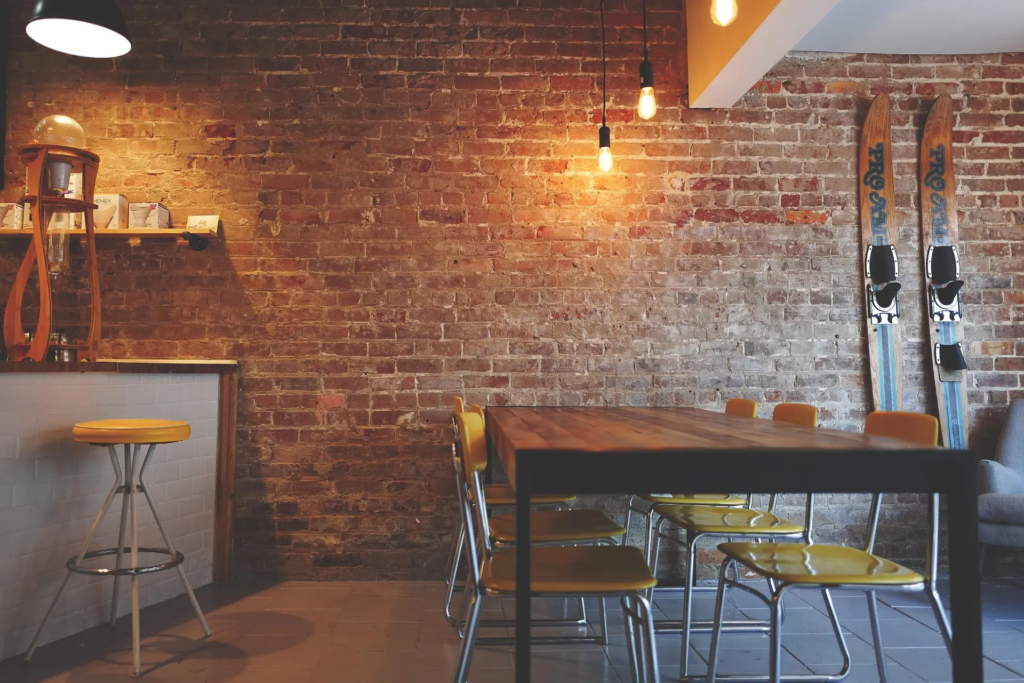
Gingham, small florals, and ticking stripe are all authentic to cottage style, but in a small room, pattern used in more than one spot competes for attention in a space that doesn’t have the square footage to let each pattern breathe. Choosing a single place for pattern — curtains, seat cushions, or a table runner, but not all three — keeps the room from feeling visually loud while still giving it the softness the style is known for.
If you’re not sure which spot to choose, curtains tend to have the most impact relative to the smallest amount of fabric, since they’re usually the largest single textile surface in a small dining room and sit at eye level where they’re immediately noticeable.

Photo by ashinJPG
3. Open Shelving Scaled to the Wall, Not the Aspiration
A plate rack or open shelf displaying collected dishware, mismatched teacups, or vintage glassware is a classic cottage element, but in a small dining room it needs to be sized to the actual wall space available, not to the sprawling, multi-shelf displays common in larger farmhouse-style rooms. A single shelf or a narrow plate rack running 24 to 36 inches, holding a curated handful of pieces rather than a dense, floor-to-ceiling collection, reads as intentional rather than crowded in a tight room.
This also has a practical upside in a smaller space: a shallow shelf (6 to 8 inches deep) doesn’t eat into the room’s already-limited walking clearance the way a deeper hutch or sideboard would.
Pro Tip: Leave visible empty space between grouped items on the shelf — roughly the width of your hand between clusters — rather than lining pieces up edge to edge. In a small room, tightly packed shelving reads as storage rather than display, while a bit of breathing room between groupings signals it’s curated.

4. Warm Wood Paired with One Painted Piece
Rather than painting every piece of furniture in the room (a common cottage instinct that can look overdone at a small scale), pairing one warm, unpainted wood piece — usually the table itself — with one painted piece, like a sideboard or a set of chairs, gives the room contrast without the flatness of an all-white or all-pastel palette. This also keeps a small room from feeling like a single block of color, which can make a tight space feel more closed-in than a room with some material variation.
If your dining room connects visually to a similarly styled living space, INTERNAL LINK: french country dining room ideas for rooms that aren’t chateau-sized covers a related approach to mixing painted and natural wood finishes at a modest scale.
5. Café Curtains for Small or Low Windows
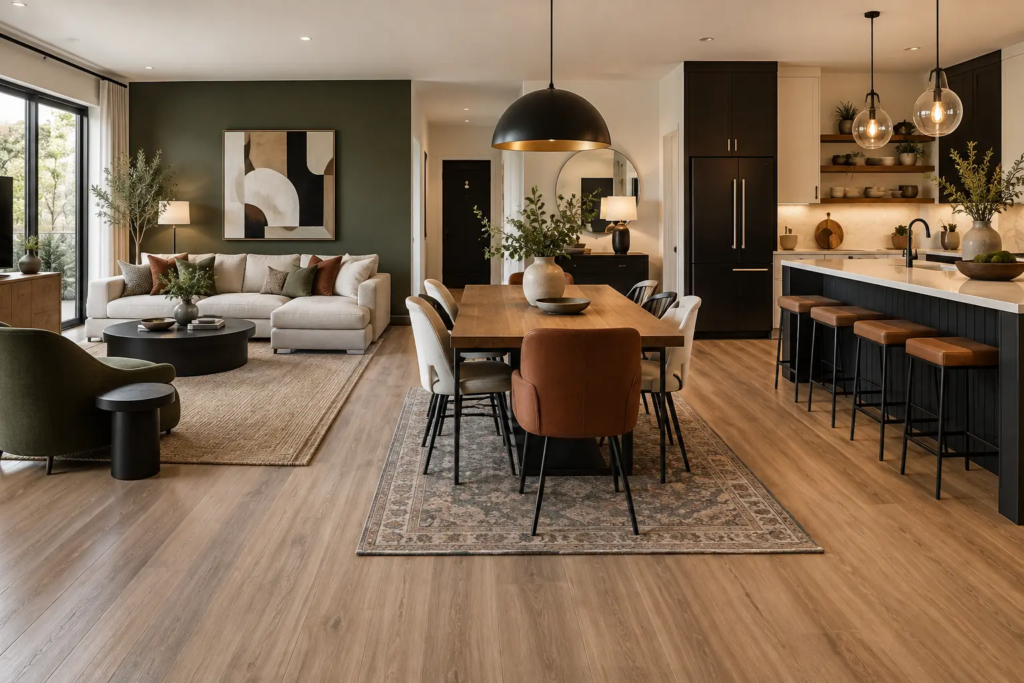
Many older cottage-style homes have smaller windows than newer construction, and floor-length curtains sized for a standard modern window can look oversized and heavy when hung on a shorter, older window frame. Café curtains — hung to cover roughly the bottom half or two-thirds of the window on a rod mounted at the window’s midpoint — are proportioned for smaller windows specifically, and they have the practical benefit of preserving natural light and privacy at the same time, since the top of the window stays uncovered.
This is also one of the more budget-friendly cottage details, since café curtains use significantly less fabric than full-length panels, making a higher-quality fabric affordable even on a smaller budget.
6. Lighting Scaled Down for Low Ceilings
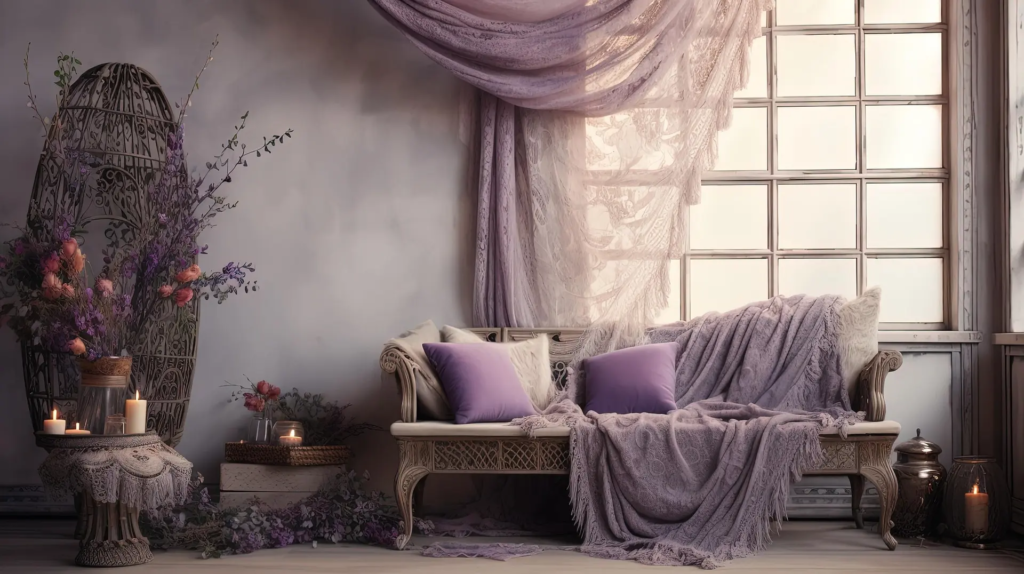
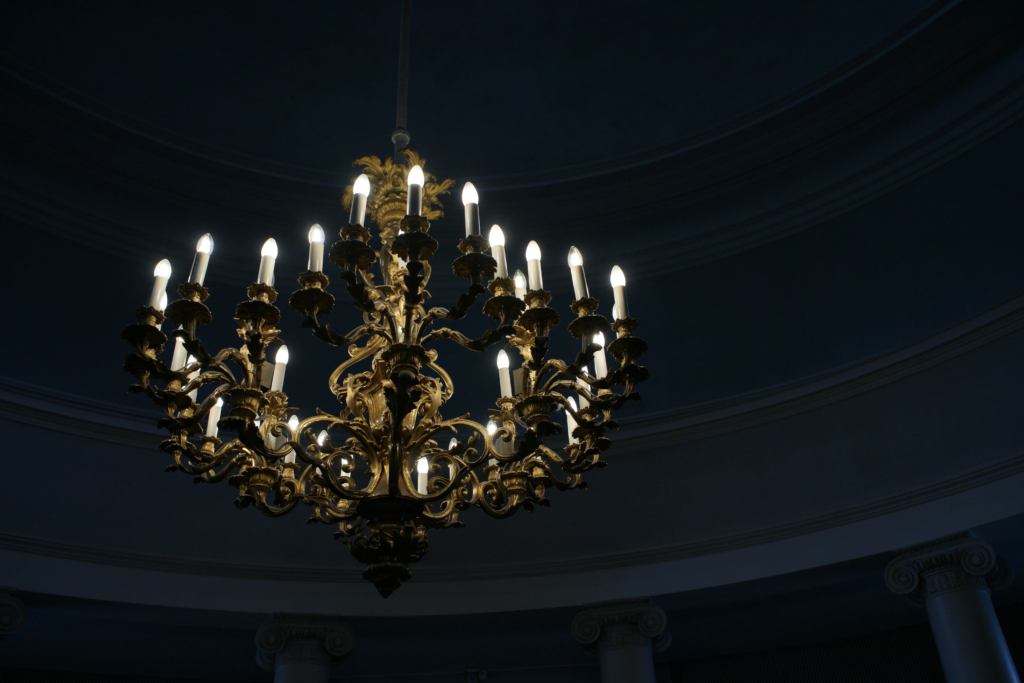
A large chandelier or an oversized multi-pendant fixture, while common in cottage-style dining rooms in larger homes, can visually lower an already-low ceiling and make a small room feel more cramped rather than charming. In a room with ceilings under roughly 8 feet, a flush-mount or semi-flush fixture, or a single smaller pendant hung with minimal drop, keeps headroom and sightlines open while still giving the room warm, ambient light.
Warm-toned bulbs (around 2700K) rather than bright white or cool-toned LEDs also matter more in a smaller room, since the light source is inevitably closer to eye level and to the table, and a cooler color temperature can read as clinical rather than cozy at that proximity.
Common Mistakes to Avoid
Using pattern in three or more places at once. As covered above, gingham curtains plus a floral rug plus patterned seat cushions in the same small room is the fastest way to tip cottage charm into visual clutter.
Choosing an oversized table for the room’s actual footprint. A farmhouse table sized for a large country kitchen can leave almost no walking clearance in a small dining room. Measure for at least 36 inches of clearance behind every chair when pulled out, and size the table down if that clearance isn’t there.
Painting every wood surface the same pastel. A room where the table, chairs, and shelving are all painted the identical soft color loses the material contrast that makes cottage style feel collected rather than manufactured.
Overcrowding open shelving. Dense, floor-to-ceiling displays work in larger farmhouse kitchens with more wall space to spare; in a small dining room, the same density reads as cluttered rather than curated.
Budget-Friendly Ways to Get the Look
Cottage style’s reliance on vintage and secondhand pieces makes it one of the more affordable styles to build gradually:
- Under $50: A single vintage teacup or plate for open shelving, a small vase for dried or fresh flowers, or a length of gingham fabric for one set of seat cushions.
- $100–$300: A pair of café curtain panels in a quality linen or cotton, or a secondhand wood chair to start a mismatched set.
- $300–$800: A compact flush-mount or small pendant light fixture sized for a low ceiling, or a secondhand table refinished rather than bought new.
Pro Tip: When shopping secondhand for mismatched chairs, bring a tape measure and prioritize matching seat height (typically 17 to 19 inches) over matching style — chairs with wildly different seat heights around the same table look uneven in a way that’s more noticeable than differences in chair back shape or wood tone.
[IMAGE: A secondhand wood chair being measured with a tape measure at the seat, next to a small stack of vintage plates and a folded length of gingham fabric]
Bringing It Together
A cottage dining room works in a small, older space when it’s built around two or three signature elements instead of all of them at once, and when every piece — the table size, the curtain length, the lighting fixture — is scaled to the room’s actual dimensions rather than to a photo shot in a much larger house. Start with the elements that are cheapest to test, like a curtain swap or one mismatched chair, and add material contrast and curated display gradually rather than furnishing the whole room in one pass.
For more general dining room styling once your cottage foundation is in place, INTERNAL LINK: dining room decor ideas covers seasonal tablescaping and finishing touches.