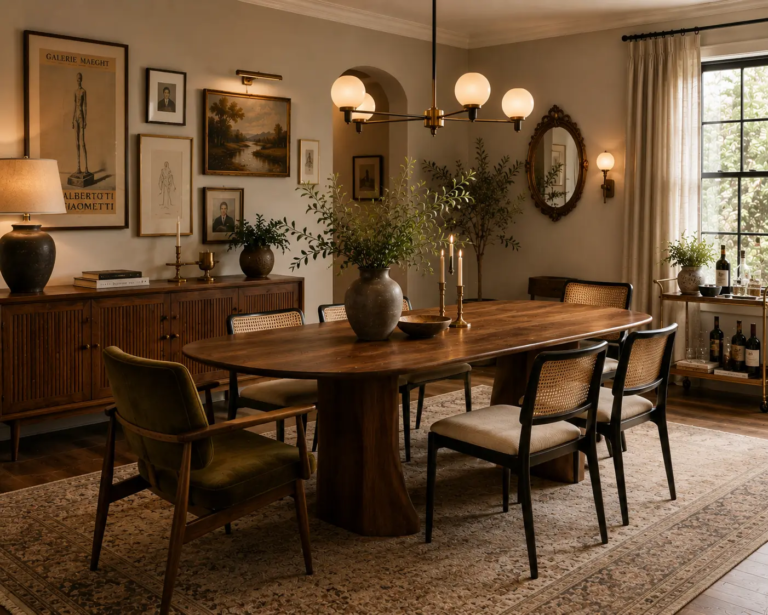
Most boho dining rooms fail the same way: a rattan chair, a macrame wall hanging, a printed runner, and a jute rug all land in one room and read less “collected over time” and more “everything from the sale rack at once.” The pieces aren’t wrong. Boho is a style built on layering, and layering without a system just looks like clutter.
The fix isn’t fewer pieces — it’s a base that holds them together. Once that’s in place, you can add texture, pattern, and warmth without tipping into visual noise. Here are eight ways to build that base, from the table itself to the shelf in the corner.
The One Rule That Keeps Boho From Looking Chaotic
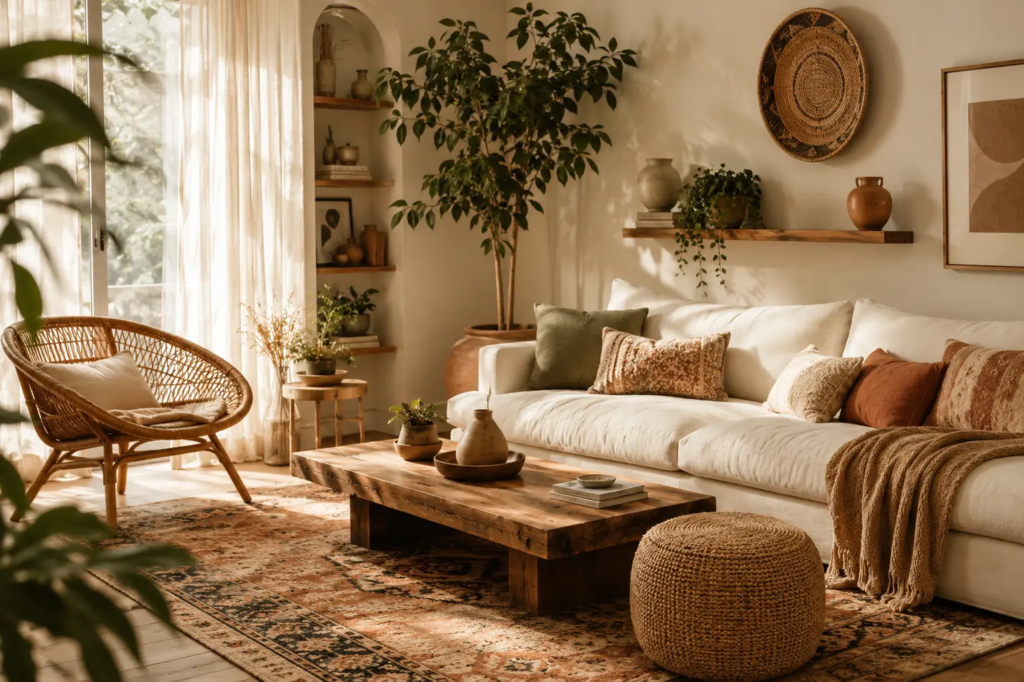
Before you touch furniture, decide on your neutral anchor: the wall color, floor, and largest textile (usually the rug) should sit in the same warm, muted family — sand, clay, oat, or warm white. That’s your constant. Pattern, color, and mixed materials get to vary because they’re set against something that doesn’t compete with them.
The second half of the rule is texture repetition. Rooms that feel intentional repeat two or three textures throughout — rattan, linen, unglazed ceramic — rather than introducing a new material with every object. A dozen different textures with no repeats reads as busy no matter how nice each piece is on its own.
Anchor the Room With a Live-Edge or Reclaimed Wood Table
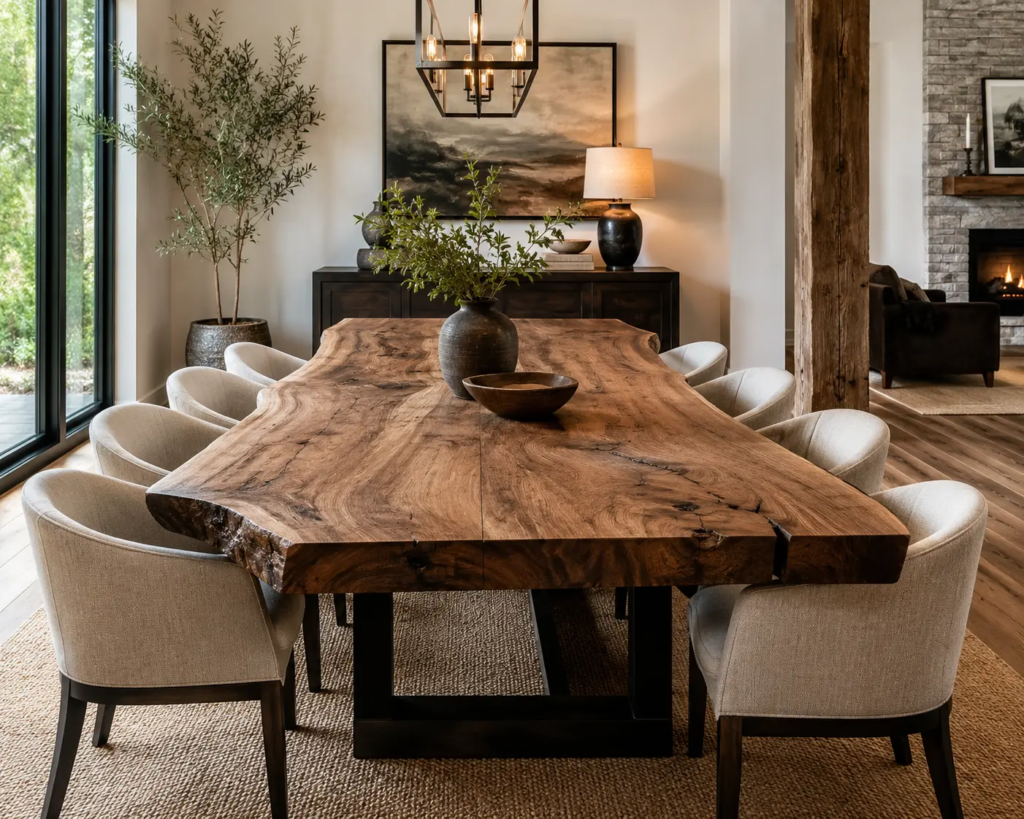
The dining table sets the tone for everything else, and wood grain does a lot of the visual work pattern usually handles. A table with visible grain, knots, or a live edge — acacia, mango wood, or reclaimed teak — gives the room organic texture before you’ve added a single accessory.
Size it correctly: for a table that seats six, plan on roughly 78 inches of length, and let the rug extend at least 24 inches past the table’s edge on all sides so chairs stay on it even when pulled out. A rug that stops right at the table’s edge is one of the fastest ways to make a room look unfinished.
Pro Tip: Unfinished or lightly oiled wood tables show water rings and scratches more than sealed ones, but they’re easier to sand and re-oil at home. If you have kids or entertain often, ask for a matte polyurethane finish instead — it keeps the organic look while resisting wear.
Mix Dining Chairs Instead of Matching Them
A full set of matching chairs is one of the quickest ways to make a boho dining room feel like a showroom instead of a home. Two approaches work.
Matched Frames, Mismatched Materials
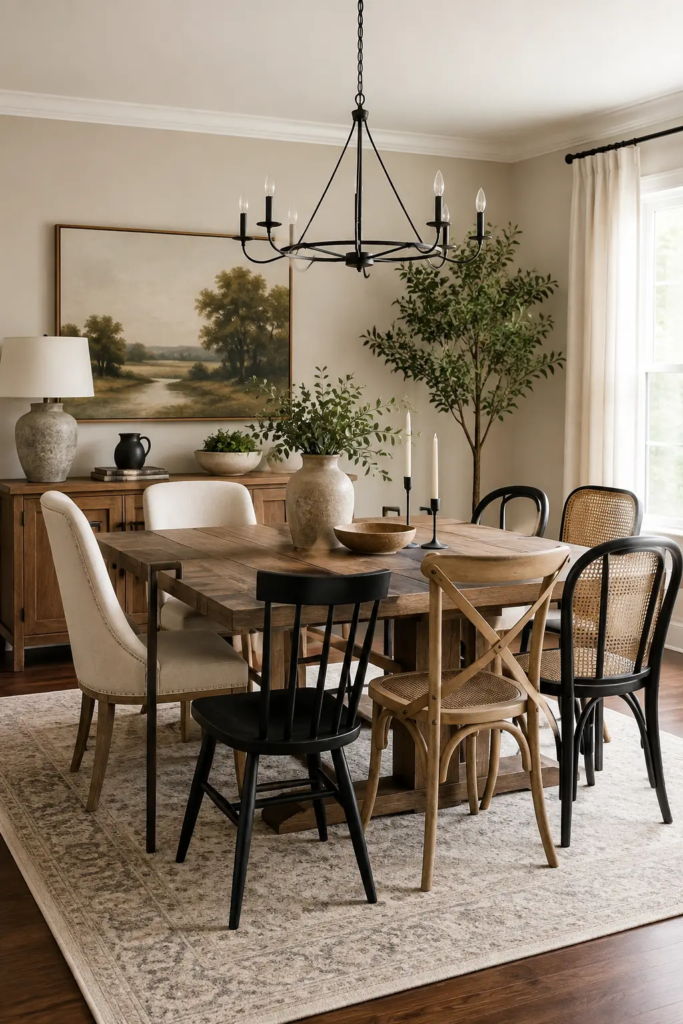
Keep the chair legs and silhouette consistent, but alternate materials — rattan-backed chairs on the sides, upholstered linen chairs as the head chairs. This keeps enough visual consistency that the room doesn’t feel random while still bringing in texture.
If you’re sourcing secondhand, unify chairs with a shared wood tone or one fabric family (cream, rust, terracotta) rather than matching the frames — color does more unifying work than shape. Either way, cap it at two or three chair styles; more than that, and the eye can’t find a pattern to rest on.
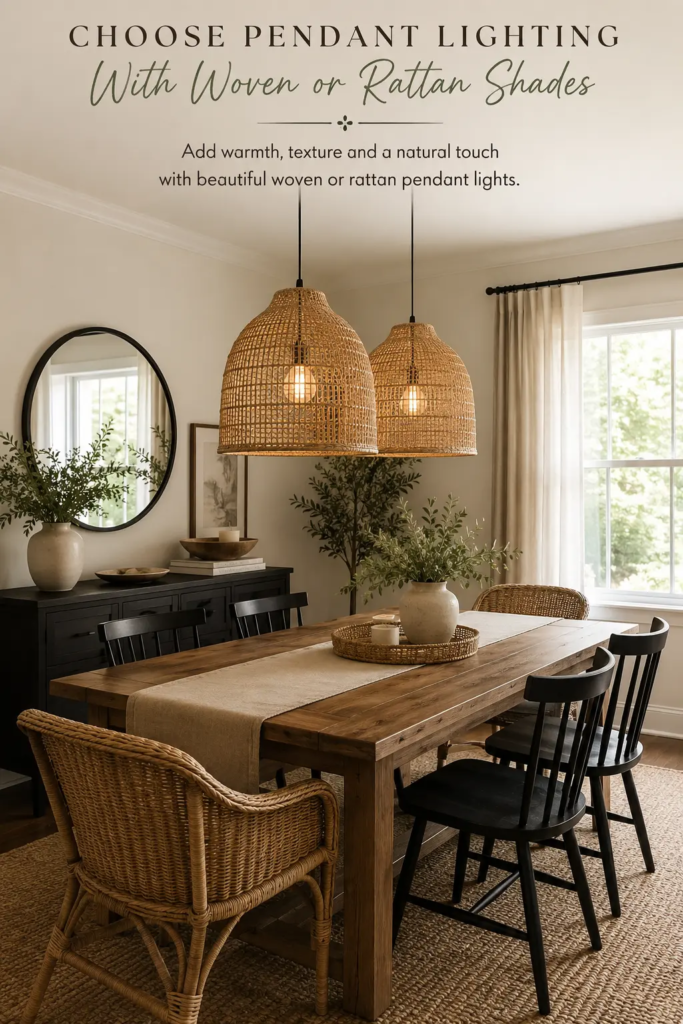
Choose Pendant Lighting With Woven or Rattan Shades
Overhead lighting is where a lot of boho dining rooms lose points, mostly because the fixture gets treated as an afterthought. A single pendant with a woven rattan, capiz shell, or paper shade adds warmth from above, which matters since most of the room’s other texture sits at table height or lower. Hang it so the bottom sits 30 to 34 inches above the tabletop — low enough to feel intimate, high enough that no one’s ducking around it.
Pro Tip: Woven shades scatter light unevenly — flattering, but not enough to eat by on its own. Add a secondary source, like wall sconces or a plug-in floor lamp, so you’re not relying on one dim fixture.
Layer Textiles on the Table, Not Just the Floor
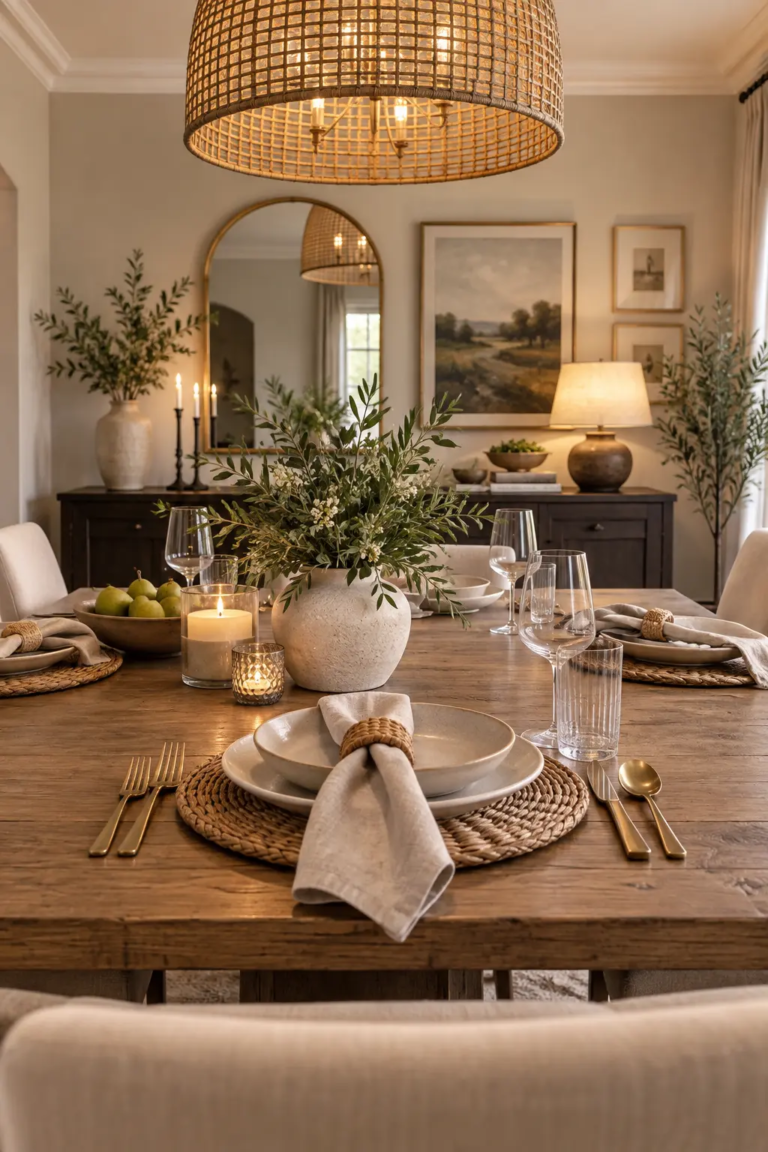
A rug does a lot of the textural heavy lifting, but the table surface is just as important and gets skipped more often. A woven runner in a natural fiber — jute, seagrass, or loosely woven cotton — breaks up a bare wood or glass tabletop and gives you a low-commitment place to introduce pattern, since it’s the easiest layer to swap out.
If you’re using a bench on one side of the table — a common boho move that also solves seating in smaller rooms — stack two or three cushions in coordinated patterns rather than one flat pad. It reads as intentional layering instead of an afterthought fix.
Pro Tip: Buy your runner slightly longer than you think you need — 12 to 16 inches of overhang on each end lets it drape rather than sit flat, which reads as gathered over time instead of store-bought.
Add One Textural Wall Moment
Boho dining rooms benefit from a single wall treatment rather than décor scattered across every wall. A large woven wall hanging, a cluster of natural-fiber baskets, or a patch of limewash or plaster texture behind the table gives the eye one clear focal point. Keep it to one wall — texture on every surface starts to feel like a stage set rather than a place to eat dinner.
Bring In Greenery That Doesn’t Need Daily Attention
Plants are core to the boho look, but a dining room gets less consistent light and attention than a living room, so pick accordingly. A trailing pothos on a high shelf or a fiddle leaf fig with decent indirect light works better here than anything needing daily watering or bright direct sun. Dried elements — pampas grass, eucalyptus, dried florals in a stoneware vase — are a legitimate alternative if the room doesn’t get much natural light, and they solve the maintenance problem entirely.
Style the Open Shelving or Bar Cart With Restraint
If your dining room has a sideboard, open shelving, or a bar cart, this is where the “collected” feeling comes together or falls apart. Group items in odd numbers — three or five — and vary height rather than lining everything up flat. Mix in a piece or two of glass or brass alongside your ceramics and baskets, and leave negative space between groupings. A shelf packed edge to edge looks cluttered no matter how well each piece fits the style.
Common Mistakes That Undercut a Boho Dining Room
Too many patterns, no shared color. Mixing four or five prints only works if they share one common color. Without that thread, the eye has nowhere to rest.
Skipping the rug. A dining room without one loses most of its warmth and texture layering. Even a smaller, budget weave does more work than none.
Going too dark on the walls. Boho leans on light bouncing off warm, pale surfaces. Deep, saturated walls can work, but need stronger artificial lighting or the texture disappears into shadow.
Buying everything from one source. A room where the chairs, table, rug, and pendant all came from the same retailer’s “boho collection” reads as staged. One secondhand piece breaks that up.
Budget-Friendly Ways to Get the Look
You don’t need a live-edge slab table to pull this off:
Table: A secondhand solid wood table, sanded and refinished with matte oil, costs a fraction of a new live-edge piece and gets the same grain-forward look.
Rug: A flatwoven jute or cotton dhurrie costs considerably less than a hand-knotted wool rug and still delivers the texture — it just won’t hold up as long underfoot.
Chairs: Buy two matching rattan chairs new for the ends, and source the rest secondhand in a coordinating wood tone.
Lighting: A woven pendant shade kit that fits over an existing fixture costs a fraction of a full replacement and installs in under an hour.
Pro Tip: Secondhand marketplaces are strongest for wood furniture and weakest for textiles — rugs and cushions get more wear and are harder to judge from photos. Spend your new-item budget on the rug; save the vintage hunting for chairs and shelving.
Frequently Asked Questions
Does a boho dining room work in a small space? Yes, as long as you scale down rather than skip the layering. Use a smaller runner, a rug sized to the table, and one or two texture layers instead of four. The principles hold at any square footage — only the quantity of objects changes.
How many patterns is too many in one dining room? Three is usually the ceiling for a small to mid-sized room — one dominant pattern (often the rug), one secondary (cushions or a runner), and one small accent. Without a shared color thread, more than that tends to compete rather than layer.
Do I need a natural fiber rug specifically, or will any rug work? Natural fibers like jute, sisal, and wool read as more authentically boho and hide crumbs and stains better than smooth synthetic weaves. A patterned wool or wool-blend rug also works if you want more color underfoot.
What wall color pairs best with a boho dining room? Warm off-whites, sand, and light clay let the natural materials stand out. For more color, terracotta or muted sage works, but plan for stronger lighting since darker walls absorb more of it.
Bringing It Together
A boho dining room comes together when you stop treating it as a pile of pieces and start treating it as one warm base with two or three repeating textures layered on top. Pick your wood tone, rug, and wall color first — that’s the part that has to agree with itself — and everything else has room to feel collected instead of crowded.
Most dining room interior advice is photographed from the doorway, the one spot nobody occupies for long. Real meals happen seated, with your eyes about 40 to 45 inches off the floor, looking at the person across from you, the wall behind them, and whatever light hangs in between. Design for that view and the…
A minimalist dining room is more than just a design trend—it is a lifestyle choice that embraces simplicity, functionality, and elegance. By eliminating unnecessary clutter and focusing on essential elements, a minimalist dining room creates a peaceful environment where family and friends can gather comfortably. Whether you live in a spacious home or a compact…
Dining Room Decor: Stylish Ideas to Create a Beautiful and Inviting Space The dining room is more than just a place to enjoy meals. It’s where families gather, friends connect, and memorable conversations happen. Whether you have a dedicated dining room or a small dining area connected to your kitchen, thoughtful design choices can transform…
A modern luxury living room is more than just a beautifully designed space—it is a reflection of refined taste, comfort, and functionality. As the heart of the home, the living room serves as a gathering place for family, guests, and moments of relaxation. Combining contemporary aesthetics with premium materials and thoughtful design elements can transform…
A vintage modern dining room usually goes wrong one of two ways. Either every piece is its own standalone “statement,” so the room feels like a showroom floor with no relationship between the objects, or one vintage piece gets dropped into an otherwise brand-new room and looks like it wandered in from a different house….
The living room is often considered the heart of the home. It is where families gather, guests are entertained, and memorable moments are shared. Because this space plays such an important role in everyday life, choosing the right living room wall color can significantly impact its appearance, atmosphere, and functionality. The perfect color can make…