7 Round Dining Room Ideas for Tight or Odd-Shaped Rooms
A rectangular table looks like the default choice, right up until you’re squeezing past a corner every time someone pulls out a chair. Round tables solve a specific problem: they have no corners to bump into and no fixed “head” that forces a particular traffic pattern around them. In a small dining room, a narrow one, or one that shares space with a kitchen or living area, that difference matters more than most style guides admit.
These 7 round dining room ideas focus on getting that shape to actually work for your space, not just how it photographs. That means sizing the table correctly, choosing a rug and light fixture that match its shape, and avoiding a few layout mistakes that show up specifically with round furniture.
Why Round Works Better in a Tight or Awkward Room
A round table’s biggest advantage in a small or oddly shaped room is that it doesn’t have hard corners eating into the walking path. A rectangular table’s corners jut into the room at four fixed points, which means someone is always navigating around one, especially in a room under about 10 feet wide. A round table’s edge curves away evenly on all sides, so the same footprint leaves more usable space at the corners of the room itself.
This matters even more in an open-plan layout, where the dining area often blends into a kitchen or living space. Without walls to define the boundary, a round table reads as its own zone more clearly than a rectangular one, because there’s no long straight edge competing visually with the lines of the surrounding cabinetry or sofa. For more on that kind of layout, these zoned kitchen-dining-living combo ideas cover the boundary-setting problem in more depth.
Size the Table to the Room, Not Just the Seat Count
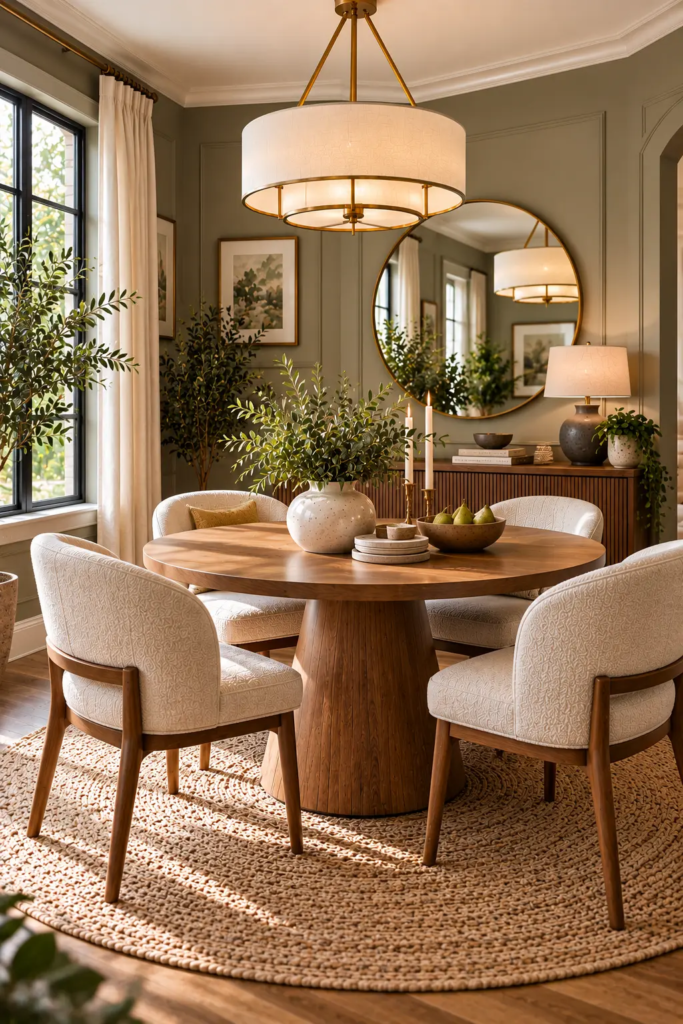
The most common mistake with round tables is sizing for seats alone and ignoring clearance. As a working guideline, allow at least 36 inches between the table’s edge and the nearest wall or furniture piece, so chairs can be pulled out and someone can walk behind a seated guest without squeezing.
For seat count, a 36-inch diameter comfortably seats four, a 48-inch diameter seats four to six, and a 60-inch diameter seats six to eight. Going larger than your room supports the 36-inch clearance rule will make the table feel oversized even if it technically fits, because there’s no breathing room around the edges.
Pro Tip: Measure your room’s shortest dimension, not the longest, and subtract 72 inches (36 inches of clearance on each side) to find your real maximum table diameter. People consistently oversize round tables by measuring the room’s length and forgetting the width is what actually constrains chair clearance.
Match the Rug Shape and Size to the Table
A square or rectangular rug under a round table creates an odd visual mismatch, with the table appearing to float off-center even when it isn’t. A round rug, or at minimum a rug with rounded corners, follows the table’s shape and reads as more intentional.
Size the rug so it extends at least 24 inches beyond the table’s edge on all sides, which keeps chair legs on the rug even when pulled out for someone to sit down. A rug that stops right at the table’s edge means chairs land half on, half off the rug the moment anyone scoots in, which looks unfinished no matter how nice the rug itself is.
Center a Pendant Directly Over the Table
Round tables have one real advantage in lighting: there’s a single obvious center point, unlike a long rectangular table where a single pendant can look off if it’s not centered on the exact middle. Hang the fixture so its center aligns with the table’s center, not the room’s center, especially if the table sits closer to one wall.
For sizing, a pendant’s diameter should run roughly one-third to one-half the table’s diameter, and the bottom of the fixture should sit 30 to 36 inches above the tabletop. Too high and the light spreads thin across the ceiling instead of the table; too low and it blocks sightlines across the table when people are seated.
Pro Tip: If your dining area shares a room with a kitchen or living space and lacks a dedicated overhead junction box, a plug-in pendant with a cord cover kit lets you hang a properly centered fixture without any electrical work. It’s a renter-friendly fix that solves the “off-center light” problem without rewiring anything.
Mix Chair Styles Around the Curve
A round table handles mismatched chairs more gracefully than a rectangular one, because there’s no obvious “head of the table” position that a different chair style would visually interrupt. This makes round tables a good fit if you’re building a dining set from pieces you already own or found secondhand rather than buying a matched set.
A common approach is alternating two chair styles evenly around the table, or using one consistent style with a couple of similar-toned but not identical chairs mixed in. For a room-specific approach to blending older and newer furniture this way, these vintage-modern dining room ideas show how that pairing plays out in practice.
Choose Materials That Suit a Smaller Footprint
Because round tables in small rooms are often on the smaller side, the material and finish carry more visual weight per square foot than they would on a large rectangular table. A glass or light wood top can make a compact round table feel less bulky in a tight room, while a dark, heavy wood top on a small table can look disproportionately heavy for its size.
Pedestal bases also tend to suit round tables better than four-leg bases in tight spaces, since a single central pedestal leaves more knee room and doesn’t create a leg to navigate around when pulling a chair in from any angle. If your room leans toward a specific style direction, these French country dining room ideas and this minimalist dining room guide both show material choices scaled for smaller rooms.
Style the Center Without Blocking Sightlines Across the Table
A round table’s shared center point means everyone at the table has a direct line of sight across it, which makes an oversized centerpiece more noticeable than it would be on a long rectangular table where people mostly talk to their immediate neighbors. Keep a centerpiece under about 12 inches tall, or split it into a few smaller low pieces spread along the center rather than one tall arrangement in the middle.
A low bowl, a cluster of short candles, or a shallow tray with a few small objects all add styling without blocking anyone’s view of the person across from them.
Common Mistakes to Avoid
- Sizing the table by seat count alone. Without checking clearance against your room’s narrowest dimension, an appropriately-seated table can still feel too big.
- Using a rectangular rug under a round table. The mismatch makes the table look off-center even when it’s placed correctly.
- Hanging the pendant off-center from the table. Centering it on the room instead of the table is a common and easily avoidable mistake.
- Choosing four-leg bases in a tight room. A pedestal base almost always gives more usable knee and chair clearance.
- Building a tall centerpiece. It blocks the one advantage a round table has: everyone can see everyone else across it.
Budget-Friendly Ways to Adapt These Ideas
Low budget: Swap a rectangular rug for a round one, lower a centerpiece to under 12 inches tall, and rehang or reposition an existing pendant to center it over the table rather than the room.
Mid budget: Add a plug-in pendant kit if you lack a centered ceiling junction box, and mix in one or two secondhand chairs around an existing table for a less matched, more intentional look.
Higher budget: Invest in a pedestal-base round table sized correctly to your room’s narrowest dimension, paired with a properly sized round rug underneath.
FAQ
Is a round table better than rectangular for a small dining room? Usually yes, because a round table has no corners jutting into the walking path, which matters most in rooms under about 10 feet wide. The right choice still depends on the room’s exact shape, but round generally gives more usable floor space per square foot of table.
What size round table fits a small dining room? As a starting point, measure your room’s narrowest dimension and subtract 72 inches for clearance on both sides; the remaining number is close to your maximum table diameter. Most small rooms end up comfortably fitting a 36- to 48-inch round table.
Do you need a round rug under a round dining table? It’s not required, but a round or rounded-corner rug matches the table’s shape and avoids the visual mismatch a square or rectangular rug creates. Whatever shape you choose, size it to extend at least 24 inches beyond the table’s edge.
How many chairs fit around a round table? A 36-inch diameter comfortably seats four, a 48-inch diameter seats four to six, and a 60-inch diameter seats six to eight, assuming standard 18- to 20-inch chair widths and enough room clearance around the table’s edge.
What pendant size works over a round dining table? Aim for a pendant diameter around one-third to one-half of the table’s diameter, hung so the bottom sits 30 to 36 inches above the tabletop, and centered directly over the table rather than the room.
The Takeaway
A round table isn’t just a style choice, it’s a layout fix for rooms where corners and fixed head-of-table seating cause real friction. Size it to your room’s narrowest dimension, match the rug and lighting to its shape, and keep the centerpiece low so sightlines stay open. Handled this way, these 7 round dining room ideas turn a cramped or awkward space into one that actually flows.